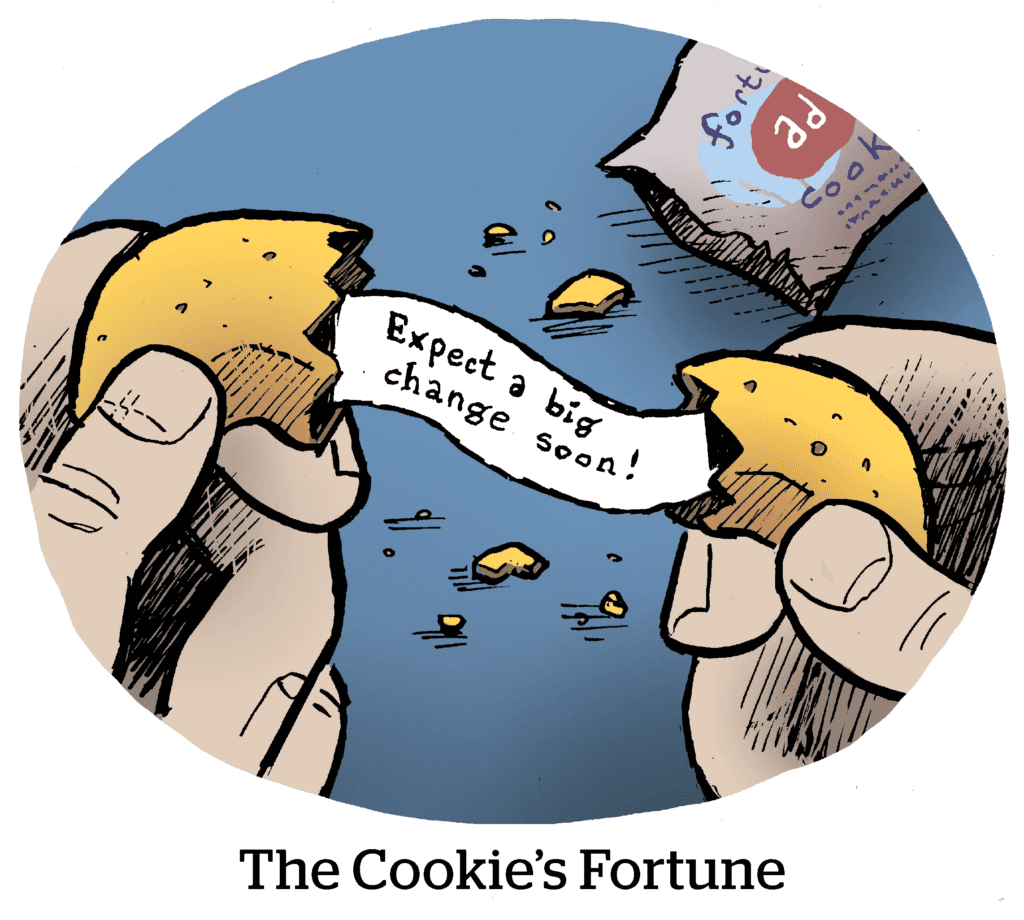
The third-party cookie saga: Has any industry ever gazed at its navel with such intensity?
I can’t count the number of stories in AdExchanger’s archives on the end of third-party cookies. We’ve got columns, op-eds, feature pieces, new articles, podcasts, thought leadership, comics, sponsored content, you name it.
And then, after more than four years, Google announced over the summer that it wasn’t gonna deprecate third-party cookies in Chrome after all. Instead, Google said it would introduce some sort of user choice mechanism.

Google didn’t share many (or really any) concrete details about the prompt at the time, and the UK’s Competition and Markets Authority (CMA) soon called for Google to update its Privacy Sandbox commitments to reflect the change in its approach.
We covered these developments ad nauseam.
Actual (as in edible) cookies
Then, for me at least, it got blessedly quiet on the third-party cookie front.
Every so often, I’d get an email pitching a story about an ad tech company that’s actively testing the Chrome Privacy Sandbox. But that’s about it.
Recently, when I searched for the word “cookies” in my Outlook inbox, the top result was actually a pitch about a holiday campaign for Oatly featuring a group of professional Santas who end up preferring oat milk and cookies to the more traditional regular milk and cookies.
Point is, cookie-related news all but dried up after Google scrapped its deprecation plans.
But at the IAB’s Annual Leadership Meeting (ALM) in Palm Springs last week, there was a little dribble of news.
A ‘one-time global prompt’
Last Monday, Google’s VP of Privacy Sandbox, Anthony Chavez, hosted a workshop at ALM with executives from Dotdash Meredith, NextRoll and Audigent about privacy-enhancing approaches to advertising.
I wasn’t in the room to hear it firsthand, unfortunately. When I got the news, I was sitting on my bed with my laptop trying to keep my cat from resting her paw on the trackpad.
But at one point during the workshop, apparently, Chavez shared a teeny tiny bit more information about Google’s planned third-party consent mechanism for Chrome. He referred to it as “a one-time global prompt.”
Although it was already out there that Google’s plan is to offer choice at the browser/account level – h/t Scott Messer who got the scoop on that last year – this is the first time that a Google person has ever officially used the language “one-time global prompt.”
I’ll pause for amazed silence – and for those of you who might be thinking, “Yeah, okay, so what?”
Reading between the lines
Well, it’s interesting to have confirmation that the choice mechanism won’t be on a site-by-site basis in the mode of Apple’s ATT, so there’s that.
Otherwise, though, “the devil is in the details,” says Jamie Barnard, CEO of privacy tech startup Compliant, and the details aren’t clear yet.
For example, although Chavez said the ad industry will have several months to prepare before the prompt goes live, he didn’t share when that would be exactly.
And timelines have a tendency to shift when we’re talking about cookies and Chrome, says Gary Kibel, a partner at Davis+Gilbert.
“Once they do activate any new functionality, it will be very impactful for the industry – but who knows when that will happen,” Kibel says. “Just like third-party cookie deprecation and the Privacy Sandbox, everything seems to get pushed back.”
 Even without more specific information, though, it’s possible to read between the lines, Barnard says.
“This looks like ‘a nuclear opt-out’ – why else would we need several months’ warning?” he says. “And if opt-out rates are high enough, this approach could be the final nail in the coffin, achieving cookie deprecation without the responsibility.”
Smoke signals
But perhaps the more important question is not what the prompt could look like but rather how it will apply in light of Google’s commitments to the CMA, which require nondiscrimination, says Stephen Dnes, a founding partner at Dnes & Felver in the UK.
Consumers differ on whether they like or dislike personalization, he says. Surveys consistently show that roughly two-thirds of people are okay with trading personal data in exchange for a service, while around 20% of people are against it.
“The key to resolving the current debate about cookies and prompts is to surface those differing preferences,” Dnes says. “By enriching these signals, rather than truncating the data, the world can move on from the stale debate about cookies.”
🙏 Thanks for reading! It’s hard to know exactly what the future holds. But regardless of what happens with Google’s choice prompt for Chrome, here’s hoping that this is what’s in store for me. As always, feel free to drop me a line at allison@adexchanger.com with any comments or feedback.