

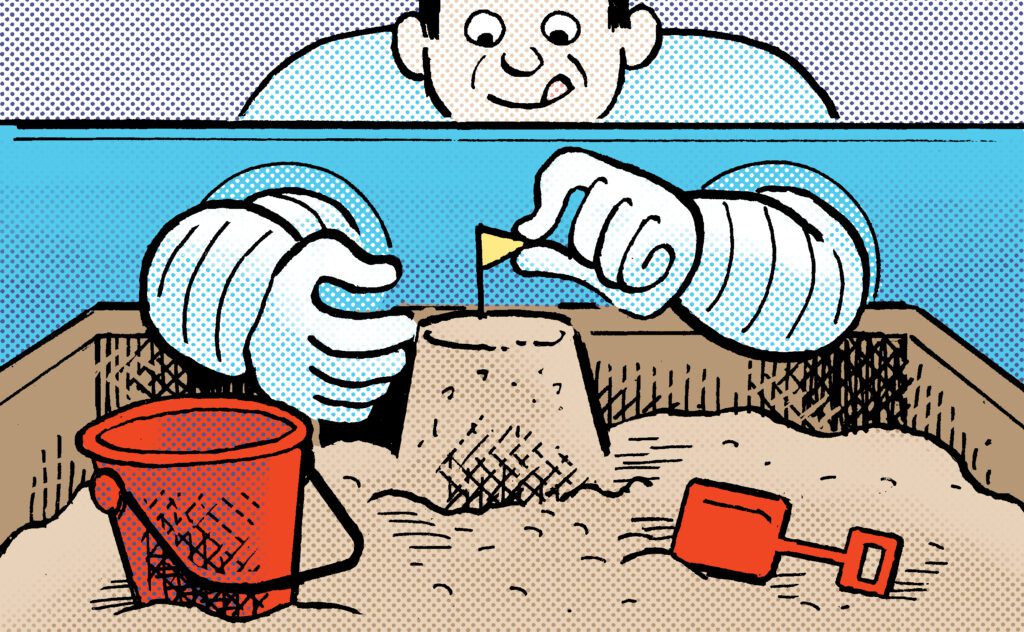
Around this time last year, there were only a handful of companies testing the Chrome Privacy Sandbox.
Fast-forward to today, and Google says there are hundreds actively building infrastructure to support testing now that the APIs have become generally available.
There’s been an enormous internal effort inside Chrome to “get as many companies as possible testing the technologies,” said Alex Cone, senior product manager for Privacy Sandbox, during a privacy panel at LUMA’s Digital Media Summit in New York City on Tuesday.
Ari Paparo, who was moderating the session, turned to the audience and asked the room: “How many people here are actually working on Sandbox initiatives?”
Four people out of roughly 50 raised their hands.

Testing the waters
Facetiousness aside, the Chrome team is getting “loads of feedback” about the Privacy Sandbox from the ad tech industry, Cone said.
And, broadly speaking, this feedback comes from two main camps: those with a desire to provide meaningful, constructive criticism and others pushing to maintain the status quo as long as possible.
RTB House falls into the former group. It was one of the first ad tech companies to start testing the Privacy Sandbox, including integrating the Topics API into its bidder way back in September 2022.
Despite the recent third-party cookie deprecation delay, starting early was a good decision, said Michael Lamb, chief commercial officer at RTB House, which, it’s relevant to note, is headquartered in Poland.
Generally speaking, he said, the Polish mentality is no nonsense, fact-based and highly rational. So, when RTB House was still deciding whether to invest in testing the Privacy Sandbox, its engineers had just two questions: Is the Privacy Sandbox a durable alternative? And is there a benefit for being early to the testing game?
A balancing act
The durability question is tricky because Google needs to strike an acceptable balance between privacy protection and competition.
The UK’s Competition and Markets Authority, which has oversight over the rollout of the Privacy Sandbox, has been investigating whether the APIs would give Google a competitive advantage in the online advertising industry once third-party cookies are eventually phased out in Chrome.
Meanwhile, the Information Commissioner’s Office in the UK, the country’s data protection regulator, recently raised concerns that the Privacy Sandbox has exploitable loopholes that make it not as privacy safe as claimed.
“The general theme,” Paparo said, “is that privacy and competition are in conflict.”
Which is why it’s not obvious whether there’s an advantage to being an early tester. The situation is uncertain, the APIs are still evolving, and the effort required to test is not trivial.
It takes significant resources – including a heck of a lot of engineering hours – to test complex technologies like those in the Privacy Sandbox.
Slowing the roll
But, according to Lamb, RTB House decided the juice (the sand?) was worth the squeeze, in part because Google has already gone so far down the road toward eventual deprecation.
“We made a bet because we thought [Google] meant it and it would be hard to roll back,” he said.
Early testing has also paid off, he said, because RTB House’s engineers were able to help shape the APIs back when they were inchoate and still went by bird names.
After several years of testing, RTB House is now in the position where the APIs “work for us,” Lamb said, and retargeting will still function once third-party cookies are fully deprecated.
But success in the Sandbox isn’t a gimme, and there remains a lot of work to do. For example, latency is still a huge issue, and there’s not yet nearly enough supply. “It’s a little bit of a train wreck,” Lamb said.
So, as frustrating (if not all that surprising) as it was when Google announced yet another deprecation delay until early next year, holding off is a good thing.
“I’m glad they slowed it down,” Lamb said. “It wasn’t quite ready to go.”









