 When Oracle acquired data technology and services company BlueKai in February, the product roadmap seemed to split. Down one avenue, BlueKai’s data-management platform (DMP) would plug a hole in the company’s Oracle Marketing Cloud stack. The second avenue circles BlueKai’s vaunted data exchange, Audience Data Marketplace.
Marketing Cloud SVP and GM Kevin Akeroyd was the immediate beneficiary of the DMP, which is being integrated with the other technologies in the stack including email marketing from Eloqua, campaign management from Responsys and content marketing from Compendium.
But Oracle’s head honcho, cofounder and CEO Larry Ellison also wanted to know what would become of the data exchange.
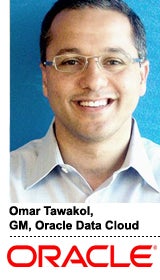
“At the time the acquisition happened, it was originally driven by Oracle Marketing Cloud pulling the BlueKai DMP into the stack,” said Omar Tawakol, BlueKai’s CEO and now GM of the Oracle Data Cloud. The data marketplace, Tawakol and his colleagues realized, “could add a third leg to the stool.”
If Oracle’s first leg is software and its second leg is hardware, then its third leg is Data-as-a-Service, hooking the BlueKai data exchange into enterprise use cases beyond marketing, like sales and commerce. As GM of Oracle Data Cloud, Tawakol is leading the centralization of some of Oracle’s social marketing acquisitions (such as Collective Intellect), BlueKai’s Audience Data Marketplace and data as a service for “groups that were natively built within Oracle for data-as-a-service, such as sales and talent management,” Tawakol said.

Extending BlueKai’s data layer beyond means connecting it with partner ecosystems like Oracle Marketing AppCloud (formerly Oracle Eloqua AppCloud) and the Oracle BlueKai Data Partner Program (about 300 data, media and privacy partners, some of which overlap with BlueKai’s Marketplace partners.)
“This is a big shift for Oracle,” said Scott Vaughan, CMO of marketing and ad tech tool Integrate, an Oracle partner. “The old Oracle – it would have been ‘us’ or ‘nobody else.’ [Now] they’re saying, ‘We’re going to help you plug into all these applications and partners,’ and that’s a really big deal if you’re a customer. That’s a significant benefit as opposed to, ‘I’ve got to go develop code now, change all our processes,’ and that’s where marketing technology gets messy.”
Oracle Data Cloud services aims to replicate the audience platform model with new data streams, Tawakal said. For instance, a marketer might use Oracle Data-as-a-Service for Social by subscribing to different “data” feeds.
“We’re listening to content across 40 million websites, video, blogs, social networks, and allowing brands to come in and subscribe to topical areas and create their own custom themes and topics,” Tawakol said. “Then you can take that data and plug it into any asset you want or into your own BI tools.”
Whereas Oracle’s data asset had previously been bundled under separate products like Oracle Campaign Management or Oracle Social Relationship Manager, now users can gain access through data à la carte.
One of the priorities for Oracle Data Cloud is developing further an identity map to include emerging platforms as connected TV or wearables, Tawakol said. This essentially means building on Oracle BlueKai email, social, offline (Datalogix drives purchase-based targeting, for instance) and mobile identifier assets.
“That’s one of the bigger areas we see an advantage with (identity) – being able to link together all these different threads on the consumer,” he said. “If you give us a social handle, we give you an email and then you can sort of see a ring developing there, a graph where any identifier can be linked to another.”
He added: “We’re not out there to do something like a Facebook or a Google or Apple or Amazon, which would be to push their identifier, what we’re trying to do is say – given any identifier, we’ll translate it to others. If you think about what we did with matching email to cookies, the best of breed folks that do that are still only at 40% coverage three years into it.”
But even Tawakol acknowledges the challenges new mediums like OTT devices could bring five years out (beyond BlueKai’s matching identifiers from social to email or email to cookie or from cookie to device. Tawakol has stated that a 100% match rate is ideal), which in and of itself is “ a massive undertaking.”
Correction: An earlier version of the story incorrectly listed the number of sites Oracle Data Cloud is accessing. The correct number is 40 million. Oracle Data Cloud is also incorporating social data feeds from the Collective Intellect acquisition.