“Data-Driven Thinking” is written by members of the media community and contains fresh ideas on the digital revolution in media.
Today’s column is written by James Rosewell, founder and CEO at 51Degrees.
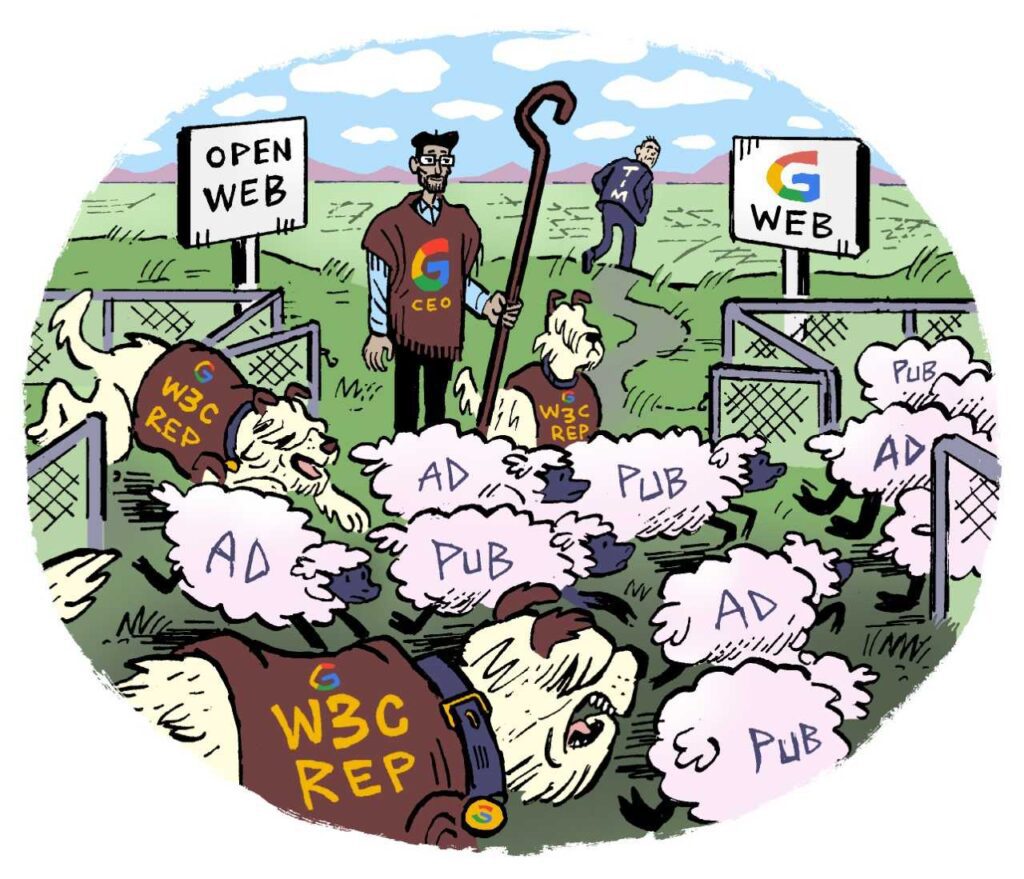
Since Google announced Privacy Sandbox, it’s used the World Wide Web Consortium (W3C) to shepherd the industry toward an outcome that benefits very few.
The overriding feeling among many at the W3C is that Google has largely ignored the feedback provided by industry and business stakeholders while promoting an understanding of protecting privacy that serves to centralize more data into Google’s own software under its exclusive control.
The ad industry and regulators can bleat all they want – but there is no substitute for action.
Common ground must be found in 2021.

 Meet: FLoC
There is a group within the W3C called the Web Incubation Community Group (WICG) where anyone can present ideas for communal discussion and experimentation. WICG has no official standing in the W3C and does not provide a route to a web standard.
Despite that, WICG is the forum where Google chose to present its Federated Learning of Cohorts, or FLoC, proposal in May, which it claims is a way to improve online advertising. FLoCs cluster devices into cohorts of similar devices based on browsing behavior.
To date, not a single other participant of WICG has endorsed the FLoC proposal.
In mid-October, however, following significant engineering investment from Google, it released results from early FLoC tests – and, like a wolf in sheep’s clothing, they were not what they seemed to be.
Wool over the eyes
According to Google, FLoCs generate a nearly 350% improvement in recall and an almost 70% improvement in precision – OK. But read the fine print: FLoCs claim to provide a lift relative to random marketing.
And who spends money randomly?! It appears that Google, which is known for its algorithmic prowess, somehow does not think marketers and publishers will see through this.
Progressing FLoC to such an advanced stage without support in the WICG – the very lightest-touch forum – coupled with these “results,” is deeply disrespectful of the time pressures facing other stakeholders as they wait for Google to make its move in Chrome.
But I would argue that FLoC, like most of Google’s Privacy Sandbox proposals, is discriminatory by design. Google is consciously removing the ability for marketers to engage audiences and, more importantly, to measure and improve their cross-publisher advertising.
For example, if the segment size of a FLoC is below a Google-defined minimum threshold, a marketer will be prevented from engaging, measuring or optimizing media spend via the open web.
Herd it here first
Google’s efforts to come up with a third-party cookie replacement are essentially an attempt to herd marketers, which are desperate for improved effectiveness, into Google’s own walled garden. If Google’s Privacy Sandbox becomes reality, there will be no comparable open web options.
And here’s a question: If Google truly believed that FLoC was better either for marketers or for people’s privacy, then why isn’t Google restricting the way in which marketers engage on YouTube to an identical cohort-based technology?
What we end up with is a splinternet. Chrome and Chromium audiences will need to be addressed differently than people using Apple’s Safari or Mozilla’s Firefox, causing even more work for publishers, marketers and their suppliers.
Casting a sheep’s eye
I am not alone in these concerns. Flip to page 229 of the US House Antitrust Report on Big Tech, and you’ll find this statement: “Though standards bodies like the W3C give the impression of being a place where browser vendors collaborate to improve the web platform; in reality Google’s monopoly position and aggressive rate of shipping non-standard features frequently reduce standards bodies to codifying web features and decisions Google has already made.”
In other words, Google needs to rethink how it engages with other companies so that it’s not pushing proposals that could be perceived as a done deal before they’ve even been properly debated.
There is still time, however, for people and their elected governments to ensure that the web is not returned to the privatized internet of the 1980s, dominated by only three companies. (Remember CompuServe, AOL and Prodigy?)
What should Google do?
For its part, Google needs to do two main things if it wishes to achieve consensus on Privacy Sandbox:
- Agree to a level of consensus that must be achieved at the W3C before progressing a proposal beyond idea stage to experimentation, public trial or mass deployment.
- Make a public statement that Google will not submit W3C proposals that would a) prevent rivals from engaging in the same collection and/or processing of personal data that Google continues to engage in and b) restrict marketers and publishers in their ability to choose who they work with in a competitive market of vendors.
These simple changes would go a long way toward helping manage expectations, placating regulators and supporting industrywide planning.
Don’t get fleeced
I know how challenging it is to keep abreast of all the proposed web changes. But by educating yourselves, you are helping ensure that the future of the web will be better than the past.
And so, please, join the W3C to engage in these important discussions and encourage your trade bodies to advocate for your business, your suppliers and your customers to be unrestricted by dominant platforms.
Follow James Rosewell (@jwrosewell), 51Degrees (@51Degreesmobi) and AdExchanger (@adexchanger) on Twitter.