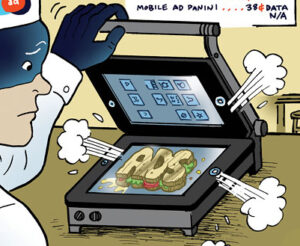
 “Data-Driven Thinking” is written by members of the media community and contains fresh ideas on the digital revolution in media.
Today’s column is written by Eric Bosco, CEO at ChoiceStream.
There has been discussion recently on whether programmatic is a strategy or not.
I believe programmatic is not a strategy, but it is strategic. Here’s why.
Programmatic media buying is a tactic that can be used to advance so many marketing strategies that it is itself strategic. Strategy, as a definition, is a plan of action or policy designed to achieve a major or overall aim. Those who say that programmatic advertising is not a plan or policy on its own are right. To increase the number of sales by advertising to consumers who may not be aware of the product or service is a plan of action; programmatic media buying is a tactic to achieve that plan.
This type of digital advertising is not an individual, independent piece of a brand’s marketing strategy. It overlaps all; programmatic advertising allows B2B and B2C companies to hit prospects at all levels of the funnel. Branding campaigns target prospects at the top of the funnel, and retargeting campaigns hit those who are lower in the funnel, closer to becoming customers.

To be clear, though, programmatic media buying isn’t simply an add-on. Programmatic campaign performance is impressive and the side benefits are essential. It’s strategic for brands to make programmatic expertise a part of their toolkit by setting aside resources dedicated to execution and the budget to fund campaigns across various strategies.
Let’s say the average company employs the following strategies for its marketing department: inbound, social, blogging, outbound email, display advertising, mobile advertising, press releases, pitching content to outside publications and speaking at industry events.
Programmatic media buying can enhance these primary strategies. In addition to using search engine optimization to pull users to a site, for example, it is wise to incorporate programmatic media buying into the inbound marketing budget. Not only will a brand attract the most likely prospects to its website, but a campaign’s flight can also deliver invaluable insight. Often times campaign optimization reveals niche markets that tend to engage with ads but were previously unbeknownst to a brand.
With social strategies, brands often purchase direct buy ads to increase followers on Facebook, Twitter and LinkedIn. Programmatic media buying should also take the stage. Programmatic actually lowers the cost of advertising for a brand, and it opens the capability of reaching out to users in real time, with messaging that is individually selected for the context of each impression and the interests of each consumer.
Email marketing allows a brand to target contacts with email addresses stored in its CRM system. There’s also the possibility to buy new contacts through data.com or something similar, but this is expensive and settling for this circumference of reach is limiting. By signing onto programmatic, you open your brand to an entirely new circle – one where a programmatic partner can incorporate third-party and proprietary data. Brands can therefore reach farther and gain traction with new users who fit the persona of top buyers.
Programmatic also enables retargeting users who engage with a brand’s content. Programmatic media buying can complement a mobile advertising strategy in a similar way. It’s cheaper than endemic. Even though personally targeted advertising is limited in mobile, it is still possible. And the same algorithms and optimization can be applied to the sites and device data that are available on most mobile traffic.
Using programmatic as a component of many different marketing strategies and across various channels gives a brand a strategic ability to amplify its lift and recall with consumers and to achieve direct-response goals.
Follow Eric Bosco (@ericbosco), ChoiceStream (@ChoiceStream) and AdExchanger (@adexchanger) on Twitter.