
 “Data Driven Thinking” is written by members of the media community and contains fresh ideas on the digital revolution in media.
Today’s column is written by John Nardone, CEO at [x+1].
It has been argued that the proliferation of ad technologies over the last few years has not really advanced our industry. Moreover, some suggest that while new technologies have (in some cases) improved performance, they have also added significant complexity, overhead and costs. As a result, the net impact to advertisers has been marginal.
On the publisher side, the situation is even worse. For publishers, technology has destroyed value and led to rapidly declining CPMs and lower revenue. To add insult to injury, many of the ad tech companies that are driving this change are wildly unprofitable themselves, sustained only by massive investments from venture capitalists that are predicated on scale that few of these companies will ever achieve.
As the CEO of an ad tech company that is tightly aligned with the marketer, it is not my focus to address the plight of the publishers. Without a doubt, new technology has created a painful shift in their business. Personally, I hope publishers can adjust their businesses to the new CPM reality so that they can thrive in a healthy ecosystem. We need them. However, my primary concern is the plight of the marketer.

I agree that marketers have not yet seen enough positive economic impact from all of this new technology to justify the investment. We are making progress though, as evidenced by the continued shift of dollars to digital. I’m also optimistic that the inevitable consolidation of ad tech over the next few years will address the impediments to improved economic value.
Marketers use ad tech to create economic value in two ways: improved efficiency and improved effectiveness. Efficiency is achieved by reducing cost and waste. Better ad targeting, for example, reduces waste and provides value by reaching the right audiences through the right channels. Effectiveness is achieved through executing current tactics in a more efficacious manner or by enabling new tactics. The ability to better match creative messages to audience segments is an example of how improved effectiveness can deliver better results and ultimately greater economic value. Both are important.
On the other side of the ledger, however, improvements in efficiency and effectiveness are counterbalanced by increased costs, which come in the form of higher fees and operational expenses. Fees are easy to quantify: simply add up what is being spent for agencies, DSPs, DMPs, tag management, attribution, verification, etc. Together they can easily amount to 25-40% of working media. But it’s the increased operations costs that are truly insidious.
Marketers often tell me that they feel overwhelmed by the complexity and ever-increasing amount of work involved with new ad technology. They tell me that identifying, evaluating and selecting from the flood of new tools is a full time job. They talk about the ongoing organizational battles to secure the technical resources needed to implement these tools. They say that even when selected technologies are implemented, it’s difficult (at best) to get all the products to work together in a meaningful way. And they tell me that the complexity of trying to reconcile mismatched data sets and contradictory analytics makes them question if the effort is really worth the trouble.
All of this only heightens the frustration they feel when market leaders habitually over-sell the effectiveness and over-promise the ease-of-use of their cobbled together acquisitions. And yet major marketers continue to invest in the promise of ad tech, despite a current view in which negative value outstrips the positive:
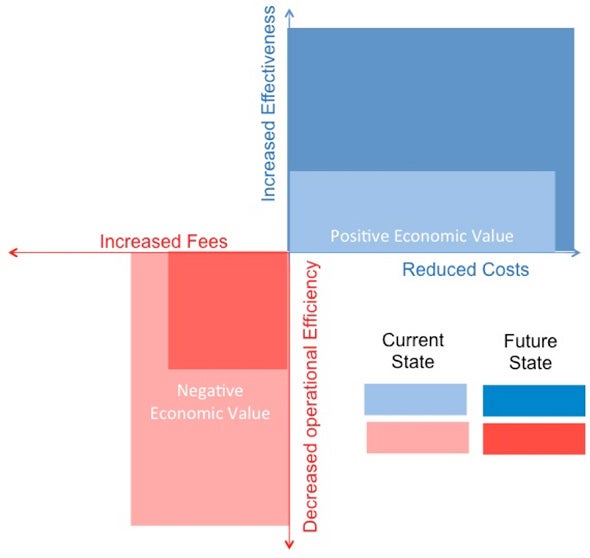
Why? Because marketers understand that there is plenty of opportunity to improve the value equation and provide real economic benefit by advancing the four vectors of effectiveness, media efficiency, operational efficiency and fees.
So, what are marketers hoping for?
1) The desire for continued improvement in media efficiency is insatiable, and marketers expect CPM’s to continue to drift downward, with some experts projecting another 12% drop in 2013. But more importantly, the ability to buy targeted impressions in premium inventory through expanding private exchanges and the use of DMP audience syndication will have a dramatic impact next year. We are likely to see the percent of display budget that is spent on highly efficient audience buying grow from approximately 13% in 2012 to more than 35% in 2013 – and include the quality inventory at the heart of the media plan.
2) Consolidation of the stack will reduce operational complexity and fees. The current state of mismatched point solutions is simply not sustainable and 2013 will be the year of consolidation. We will continue to see Google make progress in assembling features in the ad server. We will continue to see Adobe try to integrate its many acquisitions. We will see some of the agency holding companies pursue a strategy to build, buy or partner their way to a workable set of technologies. And companies like IBM, Salesforce and Oracle will continue their charge into the ad tech space with solutions focused on the end client. The result will be a trend to less operational friction, improved workflow, less data and analytic reconciliation and eventually, reduced fees.
3) Perhaps most importantly, we’ll see a shift to a broader view of marketing that isn’t limited to advertising. This shift will lead to improved operational efficacy. The expansion of audience targeting from “paid media” to include “owned media” will leverage the ad tech investment across more touchpoints and enable more effective and engaging customer experiences. In many industries, marketer-owned touchpoints far outnumber paid touches yet because owned impressions are not paid for, they are rarely seen in media plans. But these interactions are critical “moments of truth” for consumers and brand managers, and channels such as websites, call-centers, landing pages, mobile apps, Facebook pages, SMS and email can and should be optimized right alongside paid channels – and be targeted with the very same data. In the best case, concurrent management of paid and owed touchpoints will enable marketers to create highly customized and relevant experiences for consumers that are far more effective in driving sales and brand equity than anything that is available today.
We’re living through a challenging phase of transition. It’s a necessary – if painful – period. It’s a period that will resolve into something better and more effective than what we’ve had to date. That’s the optimist in me coming out. And I really think in the long-term that optimism is warranted.
We need to start delivering more value to marketers. We need to take advantage of audience-based media targeting beyond the ad exchanges; consolidate the myriad point solutions into operationally viable platforms that are less expensive to own and operate; and we need to manage paid and owned channels together on a common platform so that we can create more relevant and powerful user experiences. Tech companies that can deliver on these imperatives will help marketers flip the ad tech value equation and make technology the boon marketers need it to be.
Follow [x+1] (@xplusone) and AdExchanger (@adexchanger) on Twitter.








