“Data-Driven Thinking” is written by members of the media community and contains fresh ideas on the digital revolution in media.
Today’s column is written by Seph Zdarko, head of attribution initiatives and partner strategy at Quantcast.
Attribution is one of the most critical issues in digital advertising today. Proper attribution provides insights, incentives and controls over ad spend.
However, our current attribution models are flawed; they are too simple and easily gamed, as they measure from only the conversion event and skew metrics and incentives to bias the lower-funnel tactics. Measurement from more than just the conversion event is needed, and adding a second signal of measure further up the funnel is the right next step. If the industry chooses to adopt it, attribution will evolve to a new level of control and effectiveness.
Several of the leading attribution companies are exploring this option, but it requires greater storage and infrastructure to implement, so it needs everyone’s support. It is time to move from one signal of measure to two. This is a simple step that will have profound impact on how we view upper- and lower-funnel programmatic planning. A second point of measure will enable new metrics, insights and incentives for more efficient spend resulting in more conversions and less gaming of attribution.

The skill set and data required for effective upper-funnel prospecting is fundamentally different from lower-funnel retargeting. Ideally the two tactics work hand in hand to maximize total conversions across the full funnel. However, when only measuring from the lower-funnel conversion, they compete for credit and retargeting always wins because it is closer to the point of measure. By creating separate metrics for each phase independently, they now can work holistically together in a more efficient partnership to increase total conversions.
Adding A Second Signal For Dual Credit
Here’s how to do it: Split the funnel in two by using the first site visit as the second point to measure from. The first site visit is a natural delineation point between prospecting and retargeting. Consumers might visit a site multiple times before they convert, but retargeting can’t start until that first visit happens. This provides a clean break in the data and a natural hand-off between tactics. The site visit is the natural transition from upper and lower funnel and it touches every converter. Now we have new perspective and new metrics for prospecting and retargeting independent of each other.

Notice in the above illustration that a conversion is still required in both the upper-funnel (prospecting) and lower-funnel (retargeting) phases. That means credit is only attributed after the conversion. Just getting a site visit isn’t good enough. We still incentivize the converting customer, but now we have two separate incentive structures. Prospecting is about getting someone who has not been to a site to visit and convert; retargeting is getting someone to convert after they visit, but now they work hand in hand without competition and with full transparency.
It is important to remember that the job of your attribution model isn’t about rewarding or punishing vendors or departments on a plan. Attribution is an optimization tool for maximizing conversions. The byproduct of the optimization process is that sometimes budgets are cut, increased or decreased, but the goal should always be towards maximizing the desired outcome.
This measurement approach can produce double-digit increases in total conversions. The reality is that last touch attribution skews the influence of lower-funnel activity for traditional metrics like CPA, ROAS or ad efficiency that often result in overbudgeting and oversaturation with retargeting, meaning fewer conversions.
Let’s look at the example below:

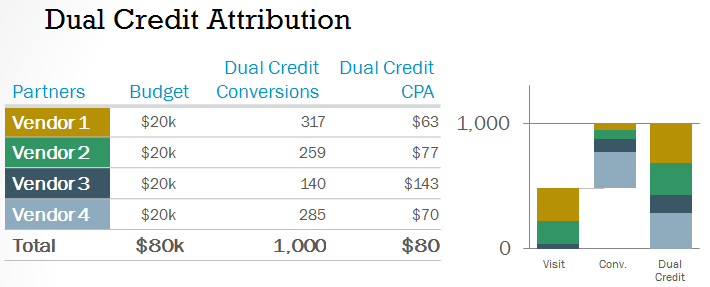
Notice the difference in CPA calculations. In the above scenario the campaign data is the same for both reports; the dual-credit report just accounts for upper-funnel metrics independently from the lower funnel and is able to break out ad effectiveness more cleanly.
It is important to note that the resulting optimizations you might enact would be vastly different based on the conversion and CPA data presented in each report. This campaign example (it has been cleaned for illustrative purposes) produces a 30% increase in conversions simply by moving budget to vendor 1, an upper-funnel prospector, and vendor 4, a retargeter. The phased partnership results in more conversions without any additional budget.
Just budgeting a balance of prospecting and retargeting tactics on a plan isn’t the same as measuring them. Dual measurement is essential for having true perspective into your marketing funnel initiatives, and this two-phased dual-credit approach is the next step.
Marketers can ultimately assign whatever value or use whatever multitouch strategy they want within each phase. It is completely flexible, provides separate incentives and is less easily gamed. While this discussion has focused primarily on programmatic, this model can, and should, be applied across all digital marketing channels.
Adding a second signal of measure provides a natural next step in the evolution of attribution today. Two-signal attribution also lays the foundation for further advancements: adding a third and fourth signal to measure from for potentially even more control and insights. But let’s not get ahead of ourselves. It’s time to give upper-funnel attribution its due respect and split the funnel!
Follow Quantcast (@Quantcast) and AdExchanger (@adexchanger) on Twitter.