SSPs? Yes, Please
Supply-side ad tech platforms – call them SSPs, ad exchanges or whatever – are at an interesting inflection point.
The whole category has been under Google’s thumb for years. But Google’s pub-side tech was declared an illegal monopoly, and there’s a sense that, perhaps, newcomers have a chance to grow.
There are also interesting strategic acquisitions potentially in the offing.

Anthropic has told its investors that it plans to start making acquisitions, The Information reports. Not that it’s shopping for an SSP. But consumer AI products like Anthropic or Perplexity may be ad tech acquirers someday if one decides to really get serious about ad revenue.
Youssef Squali, managing director and head of the Internet & Digital Media Research Group at Truist Securities, predicted at Programmatic IO NYC last month that TikTok US will likely consider an SSP acquisition once this regulatory limbo is in the past.
Airlines, credit card companies and other data-rich businesses are entering advertising and data sales, making an SSP an enticing addition.
Although, devil’s advocate, the gas and energy giant Shell did just that with its 2023 acquisition of Volta and Volta Media, an SSP built around inventory on electric car charging stations, which Shell is shuttering this year.
Brands Get Their Steps In
Social feeds are overrun by AI slop.
But there’s a flip side to the AI-generated creative revolution. Some brands and agencies are betting on outsized ROI gains for non-AI interaction and authentic spontaneity.
Which is how you end up with the latest social agency offering: Man-on-the-street-style interviews where a livestreaming content creator stops and talks to randos about your product.
The trend began organically on YouTube and moved quickly to TikTok, The Wall Street Journal reports. Creators like it because it generates (hah) “surprisingly comedic or provocative” bits.
Advertisers embraced the trend mainly because it stands out as organic in a feed. Also, agencies can filter out negative responses, whereas an influencer may livestream some unfortunate candid product reviews.
The men’s deodorant and cologne brand Huron adopted the format partly because it creates a compelling way to demonstrate smell through an ad, says Co-Founder and CEO Matt Mullenax.
But, most importantly, no advertiser wants to make an ad.
“Your ads cannot look like ads anymore,” says Josh Suggs, a 22-year-old founder of a social agency that focuses on these man-on-the-street videos.
The Slop Slowdown
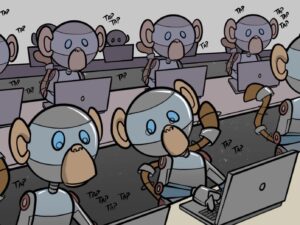
AI-written content is now slightly more common online than human writing.
In a recent study, SEO firm Graphite examined 65,000 random pages published between 2020 and 2025. It found that, as of May 2025, 52% of articles were written by AI.
The prevalence of AI-generated content exploded with the launch of ChatGPT in November 2022. Over 2023, AI content grew from 7.75% to 39%.
But, since then, AI’s growth has plateaued. By November 2024, AI content represented 51% of pages, nearly equivalent to the most recent percentage of 52%.
The slowdown in AI’s exponential growth contradicts earlier predictions that it would quickly dominate the web, according to Axios. For example, Europol, the EU’s law-enforcement arm, predicted that 90% of web content would be AI-generated by 2026.
However, search platforms are keeping AI content de-indexed, which may be contributing to the slowdown. A separate Graphite study found that 86% of Google search results are human-written, alongside 82% of articles cited by ChatGPT and Perplexity.
Still, fighting the rise of low-quality AI content is emerging as the next front in the ad industry’s crusade against made-for-advertising sites.
“AI slop, at the end of the day, is MFA,” said Mediavine’s Eric Hochberger at Tuesday’s Prebid Summit.
But Wait! There’s More!
Walmart’s newly announced deal with OpenAI is driving record highs for the retailer’s stock prices. [Business Insider]
NBC News eliminates 150 staffers from teams specializing in news related to Black, Asian American, Latino and LGBTQ+ groups. [The Wrap]
How digital billboards changed the out-of-home game. [Marketing Brew]
Are LLM visibility trackers worth the money for publishers? [Search Engine Journal]
Meanwhile, Japan’s government has made a formal request that OpenAI stop its Sora 2 product from infringing on copyrighted Japanese anime, manga and game artwork. [IGN]
An actual human woman named Tilly Norwood – the same name given to Particle6’s AI-generated actress character – appeared in a Mint Mobile ad alongside Ryan Reynolds. [Variety]
Roku is updating its voice assistant with AI features that answer questions about movies and TV shows. [The Verge]
You’re Hired!
Josh Krichefski joins PMG as EMEA president. [release]
Vinny Rinaldi is promoted to The Hershey Company’s VP of Consumer Connections. [post]