This article is sponsored by the Post-IDFA Alliance including Chartboost, Fyber, InMobi, Liftoff, Singular, Adcolony and Vungle.
Last June, Apple announced the beginning of the end for the Identifier for Advertisers (IDFA) at the app level. Starting with the upcoming iOS 14.5 update, app publishers, DSPs and mobile measurement partners will no longer have default access to the IDFA data that has long provided the foundation for granular attribution across the mobile advertising ecosystem. Instead, Apple will provide privacy centric attribution through its SKAdNetwork (SKAN) and App Tracking Transparency (ATT) framework to protect those users who opt out of IDFA sharing.
For advertisers and publishers in this space – as well as demand-side, supply-side and measurement platforms – these changes will have far reaching implications for the way ad inventory is programmatically served and measured in the post IDFA environment. For starters, publisher apps will need to support SKAdNetwork in order to ensure that the install and event conversions can be measured on devices that run iOS 14.5 and beyond. Failure to do so would mean that those conversions cannot be measured in ways that are compliant with Apple’s ATT framework. This would have a cascading effect for marketers, who depend on this attribution data to target key consumers, bid on inventory and measure conversions.
Despite the essential nature of this information, the mobile app industry has been slow to prepare for this monumental change. According to research conducted by Liftoff, only 17% of supply-side inventory is currently SKAN compatible, as of Feb. 17. At the same time, iOS updates tend to be adopted fairly quickly. It is expected that approximately 65% of iOS impressions will be subject to the new ATT framework within the first 40 days of the launch as users update to the latest version. This should concern advertisers, says Andry Supian, Group Product Manager at Liftoff, as the iOS update may be only a few weeks away.
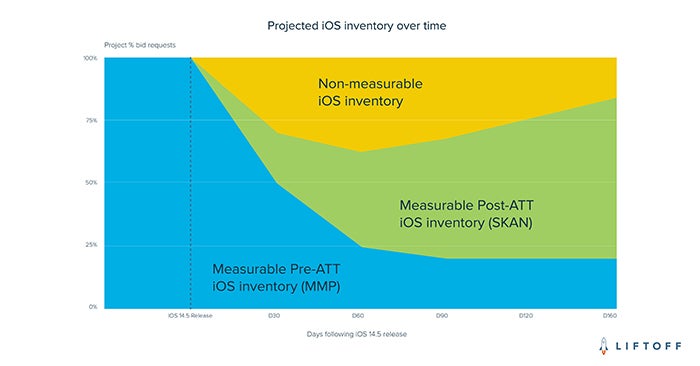
“Right now, less than a quarter of ad inventory is SKAN compatible,” Supian said. “If you extrapolate that conservatively over the next month or two, we expect that number to reach 50% by the time the new iOS version drops. This amounts to a huge reduction in inventory, and could quickly lead to a host of other problems.”
Some of the most likely problems include declines in revenue for publishers, increased pricing, reduced reach, and rising CPI and CPA costs.
To ensure this doomsday scenario doesn’t come to pass, the mobile app industry is moving quickly to make up for lost time. The Post-IDFA Alliance, a group of mobile companies focused on addressing the IDFA concerns of mobile marketers and app publishers, are working together to transition the mobile industry to the new, privacy-centric advertising environment before the update arrives.


Since the official announcement in June, the Post-IDFA Alliance has focused on testing and evolving contextual attribution strategies to help the entire mobile ecosystem – including DSPs, SSPs and measurement platforms – to transition as seamlessly as possible. However, before the industry can focus on restoring performance in this new environment, it must first focus on prioritizing the smooth adoption of the foundational ATT framework that will make this new attribution engine run.
“The key first step is focusing on the current supply side issue,” Supian said. “Updating publisher apps to be SKAN compliant is a critical precursor to attribution. From this point until the go-live date for iOS 14.5, we need to get the supply side prepared so we don’t experience a rapid drop in inventory.”
To speed this process, and avoid the doomsday scenario, there are two things publishers can do in the coming weeks to prepare:
- Update supply partner SDKs to the latest version. The sooner publishers release their updated apps, the more likely they are to resolve any lingering issues and maximize the number of users on the latest version.
- Add the complete list of SKAdNetwork IDs from supply partners to info.plist. For every app, this list defines which supply partners will have permission to get attribution. Publishers will need to manually add every single network they work with to ensure they can receive postbacks moving forward.
In the post-ATT environment, mobile attribution will look different. But iOS audiences remain too important to advertisers to let them slip through the cracks. By tackling these challenges one by one, the mobile ecosystem can minimize the disruptions created by iOS 14.5 and quickly restore high-impact advertising strategies that allow advertisers, DSPs, SSPs, publishers and measurement platforms to thrive.
To learn more about the Post-IDFA Alliance and their efforts to support a seamless transition to a more privacy-centric mobile advertising environment, visit noidfanoproblem.com.