The phrase “subscription fatigue” typically applies to consumers tiring of the ever-growing number of media and entertainment packages.
But subscription fatigue could also describe how DTC and ecommerce brands feel about their SaaS costs and vendor rosters.

The mass of SaaS
Subscription-based tech companies have come on strong in the past few years.
Many companies with an eye on ad tech’s business forego any cut of the media spend, preferring instead to sell on a subscription or a cloud model, where payment is tied to data consumption.
It makes sense. There are so many hungry mouths in digital advertising. And burgeoning retail media businesses are quick to test subscription software but won’t concede a percent of the media budget because that would cut the vendor in on future growth in ad revenue.
Then there’s the “plus” factor. Investors simply love subscription revenue, from big broadcasters and telcos to marketing tech.
But SaaS businesses are due for a major reset, according to four ecommerce-native brand founders who spoke with AdExchanger anonymously to discuss their vendors.
A SaaS too far
Subscription software tech has such a strong grip on the market, partly because it’s preferred by investors, who see it as more durable, said one startup cosmetic brand founder. Ad budgets are ephemeral; they flit from place to place and can quickly disappear.
The assumption is that SaaS businesses make it hard to leave (aka, “stickiness”).
But the thing is, subscription budgets can disappear as well, said that same DTC cosmetics CEO. “There is a comeuppance coming for SaaS,” she said.
There’s evidence to support the SaaS overexpansion thesis.
Benedict Evans, a tech industry analyst and former VC investor, published a report last year using data from SaaS product Okta to track the average number of SaaS applications used by different businesses between 2017 and 2020. For retailers, the number of SaaS accounts jumped from 75 to almost 125, while tech companies went from 100 to about 160.
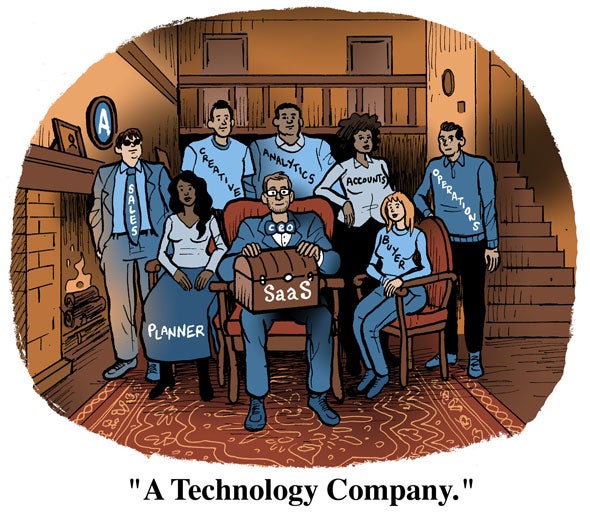
Companies like Adobe, Oracle and Salesforce pitch themselves as an antidote to SaaS saturation, similar to paying for a cable bundle rather than 20 random streaming apps, said a DTC clothing company founder.
 But the unfortunate truth, he said, is that a business ends up with one of those major cloud marketing vendors and a platoon of other solutions, often even outside SaaS vendors.
The SaaS stack builds up fast:
- There’s Klaviyo for email.
- Shopify, of course.
- You can’t forget your post-purchase survey vendor, and another for managing customer reviews.
- Testing SaaS vendors for SMS messaging and zero-party data collection is important.
- HR software, like Kazoo or Workday, becomes necessary at some point.
- Snowflake is probably on the list.
- Measured is the expensive SaaS attribution tech, but you’re also probably experimenting with Triple Whale.
- Then there’s a SaaS product just to make sense of all the other SaaS data feeds.
You get the point.
Getting passed SaaS
The true SaaS killer is generative AI, though.
But for all the frustration with SaaS vendors – “I got into ecommerce to avoid paying rent,” joked one DTC founder about all the fixed online costs she pays per month – entrepreneurs just couldn’t shake them.
In a cutback on SaaS costs last year, one DTC food brand founder told me he’d gone through the vendor roster one by one and found only a couple of companies that didn’t pull their weight. As a lump sum, SaaS accounts for too much, he said, but each vendor is pretty sticky, especially when considering the potential moving costs.
Another ecommerce CPG brand CEO said his company began paying a fee to OpenAI to use ChatGPT, which generates code and handles some repetitive tasks, like managing a schedule or budget items. So much for the tools that used to do those tasks.
 Over the past month or so, using generative AI allowed the brand to drop two of its SaaS vendors, and the CEO told me that more vendors will be cut as ChatGPT develops and the business finds others ways to put generative AI tech to use.
So, what’s the prognosis for SaaS?
“SaaS is Dead,” trumpeted Sean Frank, founder and CEO of wallet maker Ridge, in a Substack newsletter this week. He views this as a positive development since SaaS investments can shift to product development and improvement.
Take Yotpo. In 2011, when it came out, he wrote, Yotpo was a huge value add to help improve and promote customer reviews for about $500 per month. Now it’s a cost center at thousands of dollars per month.
Rather than shelling out, you can simply pay OpenAI $20 and feed it the prompts: “Please create a review software plugin that works with Shopify,” and then ask it to build the code.
So, eff SaaS vendors, Frank said (only he didn’t say “eff”).
They’re “exploiting the burden of switching,” he said. “They are not your friend.”