

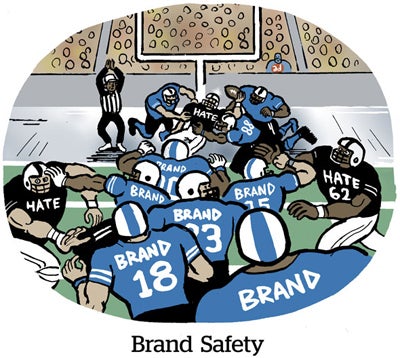
By now, advertisers’ wariness toward news is old news, and this skepticism is only increasing.
Concern over brand safety and suitability is now tied with campaign underperformance as the top reason why advertisers pull back on budget.
It’s not (just) about the money, money, money…
According to a report about trust in advertising published by Advertiser Perceptions in April, 41% of buyers cite issues with performance as their main rationale for curtailing ad spending. An equal number cite brand safety.

Thirty-eight percent said they were worried about a media company’s reputation, such as X, which has been losing support since its acquisition by Elon Musk, and supporting harmful media environments, like those that feature hate speech or violence.
The report is based on a poll of 301 advertising professionals – 60% agency folks and 40% in-house at brands – on their values and spending choices.
Lip service
It’s been proven that ads adjacent to divisive or upsetting news stories perform as well as those that appear alongside “safer” topics, yet brands remain wary, which has had a negative impact on monetization for news publishers.
Although 70% of buyers told Advertiser Perceptions they believe advertising in “legitimate news environments” has a positive or neutral impact on most of their customers, that’s down from 75% last year.
Meanwhile, the majority of those polled say their own organization is in favor of supporting news publishers with ad dollars, which is great … except that number declined from 66% in 2024 to 55% this year.
On top of that, the number of buyers who believe it’s important that ad dollars – generally speaking, not specifically their own – should support high-quality journalism and news sites declined seven points over the course of nine months.
New news
But it’s worth noting that the reasons for these declines go beyond brand safety and suitability fears.
For example, younger demographics are less likely to consume news in a traditional way (i.e., directly from a news site or newspaper), which means brands that cater to younger audiences must find new platforms to reach them, said Stuart Schneiderman, EVP of business intelligence at Advertiser Perceptions.
In other words, news sites are getting less popular – and attracting fewer ad dollars – due to general disinterest.
Although, “if you want to be glass half full,” Schneiderman said, it at least remains true that the majority of buyers are still in favor of advertising on news platforms and supporting quality journalism – just a lesser majority than before.
To many advertisers, the news creates a catch-22 situation: Either advertise on sites with potentially negative or harmful content and alienate some of your audience base or play it safe with exclusion lists at the expense of, well, pretty much all news publishers.
But it doesn’t need to be so cut and dried.
There’s a big difference between websites with truly harmful, or at least distasteful, content and news sites posting factually about upsetting world events. Advertisers need to trust their audiences to tell the difference.
A few (social) issues
The current political climate appears to be influencing ad spending decisions, too, however, making buyers more cautious to support social issues.
Twenty-one percent of advertisers polled by Advertiser Perceptions report no plans to incorporate any social issues into their marketing, up from 16% in 2024.
This reticence has the potential to alienate consumers, especially the customers of companies that are seen to be pulling back on their previous commitments to social causes. It also brings into question what, exactly, is meant by “brand safety.”
Rather than incorporating their audience’s values and priorities into their advertising, they’re choosing to pull back. “Brand safety,” in this context, is low risk, low reward.
Still, 38% of brands claim to be prioritizing diversity, equity and inclusion this year – similar to last year, in spite of the nationwide shift away from DEI policies at numerous major corporations.
At many brands, supporting social issues remains a high priority, with 26% supporting mental health and 24% supporting anti-racism and social justice. There has also been an increase in the prioritization of LGBTQ issues and positive content environments.
“To see that play out was gratifying,” Schneiderman told AdExchanger. “And a bit of a surprise.”






