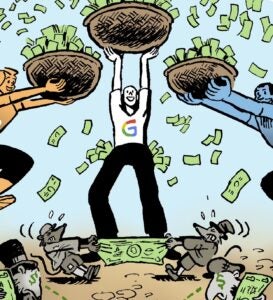
Although it’s too early to predict how the antitrust lawsuits filed against Google and Facebook late last year will play out, one immediate outcome is more awareness of how digital advertising functions.
“Many of the topics we’ve been so obsessed with in the ad tech industry are no longer just being talked about within the digital teams,” said Isabelle Baas, managing partner for digital, data and tech at Publicis-owned media agency Starcom. “Ad tech is starting to become more mainstream news, and it’s good to see.”
For example, conversations about ad tech are starting to happen in the boardroom, which could trigger more diversified media budget allocations.
“Google and Facebook have always had a very strong foothold with senior stakeholders,” Baas said. “That’s part of what’s allowed them to gain such a large part of the digital investment.”
Baas spoke with AdExchanger about the phaseout of third-party cookies in Chrome, industry efforts to replace them and what she’s been hearing from clients about the work that’s being done at the W3C. (Spoiler alert, not a lot.)

AdExchanger: What are your brand clients asking you about the demise of third-party cookies, if anything?
ISABELLE BAAS: It’s the larger advertisers, the ones with more resources, who are asking, and they’re worried, even if they’re not spending a large amount of money in digital as a proportion of overall spend. They want to know what to do and we’re involved with them in testing various solutions, helping them maximize their first-party data and building up the right publisher relationships.
On the other end of the spectrum are advertisers that don’t even ask. We try to give them as much thought leadership as we think they need, but they’re either totally wrapped up in their own world or they have other challenges to think about, so they’re leaving this to their media agency.
Have any of your clients ever expressed an interest in getting involved in the discussions happening at the World Wide Web Consortium? There’s the feeling that brands aren’t making themselves heard in that venue.
We’ve had quite a lot of advertisers interested in things like blockchain, supply path optimization and auditing the programmatic value chain. But in terms of the Privacy Sandbox, we haven’t had any advertisers put their hand up.
What do you think about the viability of identity-related industry initiatives such as Unified ID 2.0?
We’re supportive of these sort of initiatives, because we want a free and open web. We also want to see publishers do well and monetize their inventory, although in a more privacy-concentrated way. Unified ID 2.0 is a step towards that. There needs to be a value exchange between publishers and people who consume content for free.
And so it’s good to see that publishers are starting to sign up, because they’re a very important part of this.
But the challenge we tend to have with this is: Can it scale?
Will the end of third-party cookies push even more money away from the open web?
Definitely – and it’s already happened, too, with ITP [Intelligent Tracking Prevention]. In that case, more money went to Chrome inventory. Algorithms optimize towards what’s available to them, and Chrome is what was available to them.
We’re investing in our own solutions and we also keep testing other identity-based solutions and scaling first-party data for our clients.
What are your solutions?
[Publicis] acquired Epsilon, and it’ll be interesting to see how much more precise and accurate our ID can be as we leverage that solution more at scale across the globe. Even the best-in-class providers are challenged on that. Match rates are not what they used to be anymore and it depends on how you get access to a user and how you’re able to enrich and define the audience your clients are going after.
There are lots of so-called cookieless solutions coming out of the woodwork from vendors. Are they largely legit?
It really depends on what’s relevant to an advertiser. The first thing I do is go and talk to the buyers, because if they don’t think it’s relevant, then there’s no point.
A lot of these solutions are contextually based. But although context is important, so is audience, and so we need to get to a good balance there. Cookieless solutions that are more on the identity side work differently for different advertisers depending on the type of data and the market vertical they’re working in.
This interview has been edited and condensed.