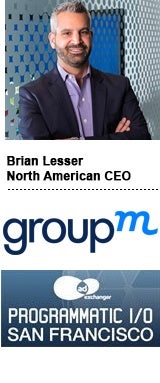
 Brian Lesser, CEO of GroupM North America, will speak at Programmatic IO on April 5 in San Francisco.
Marketers are under pressure to transform their businesses around digital while keeping costs low, so agencies have to evolve their business models to meet these demands.
At GroupM, that evolution has played out with the launch of mPlatform, which makes technology and service offerings across the organization more available to clients on an a la carte basis.
“We need to be more modular and flexible in our business model,” said GroupM North American CEO Brian Lesser. “And we need to push toward performance-based compensation so we can drive toward value for our clients.”
Lesser spoke with AdExchanger.
AdExchanger: What’s the macroenvironment like for GroupM clients, given pressure driven by investors and procurement to keep marketing costs low?
BRIAN LESSER: The advertising business is changing, precipitated by the mass proliferation of channels and devices that consumers have and the different ways they can consume content. Our business has to change along with that.
We need to be more platform and technology led in how we identify audiences, more modular and flexible in our business model and push toward performance-based compensation so we can drive value for our clients.

How is GroupM being more modular and flexible for clients?
Clients are evolving how they think about media planning and activation. In some cases, they want to own pieces of the value chain, particularly in the areas of data, analytics and programmatic. They want to own technology relationships and they want better integration between their internal teams and their service provider, whether that’s the media agency, a creative agency or a third party.
We need to flex [to] how they want to engage the marketplace. The days of building an all-inclusive staff plan that spans all aspects of media and creative are outdated. When we engage with clients, we price out the services they need. Whenever possible, we price that on a performance basis.
We are reorganizing so that all of our data-centric and audience-driven services like programmatic, search, social and analytics are joined up and integrated seamlessly into our agencies.
A lot of Xaxis leadership have moved into mPlatform roles. Where does that leave Xaxis?
Xaxis continues to be a performance-driven, proprietary model for advertisers. In the context of GroupM and mPlatform, it will drive more toward an outcomes-based business, like guaranteed viewability and performance.
Xaxis will continue to take proprietary positions in the marketplace with respect to inventory, data and technology. It will also continue to be an opt-in model.
How will WPP creative agencies access mPlatform?
The objective is to have mPlatform inform creative strategy that is consistent with media strategy.
Typically, a client has a media brief, but they have a separate creative brief. When a client is using mPlatform across both creative and media, they’d have one brief that informs both the creative message and the media activation strategy.
How does GroupM work in a world dominated by at least two massive walled gardens?
Through WPP, we have over 200 million user records in the US alone that we use as a deterministic match. But we also work with other third-party data providers and use our second-party data to amplify what we know about the consumer. That allows us to see over walled gardens and have knowledge asymmetry with our trading partners.
We know more about consumers than our trading partners as a function of having first-party data within WPP, which is personally identifiable, deterministic data. We’re also working with the marketplace to build out probabilistic models.
What’s GroupM’s focus going into 2017?
There’s a tremendous amount of complexity in media. We’re using data to inform our media allocation optimization and measurement decisions.
One area that’s particularly important for us is media integrity and making sure our advertisers have viewability of their ads, are in brand-safe environments and that we measure them apples to apples across all channels. That’s our focus.
This interview has been edited and condensed.