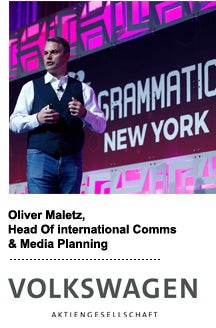
If there’s one thing that frustrates Oliver Maletz, Volkswagen AG’s head of international communications and media planning, it’s paying for nonviewable ads.
His complaint is a perennial one. Advertisers have been banging the viewability drum for years, but it remains a major pet peeve.
“Marketers should not have to pay for an ad that a human being couldn’t see, I don’t care what the technology says,” Maletz said Tuesday at AdExchanger’s Programmtic IO in New York City.
“I’m not the only one who feels that way,” Maletz said, pointing to recent research from eMarketer, which found that 97% of advertisers aren’t pleased with the industry’s definition of viewability.
Of course, the opportunity to be seen is different from the ongoing debate about what constitutes an acceptable number of pixels on screen before an ad should be counted as viewable, but a minimum of 50% of pixels on screen – one second for display, two continuous seconds for video – just isn’t enough, Maletz said.
VW wants 100% or bust. The brand is running conversion analyses to identify an appropriate time variable – it will probably be two to three seconds – but for pixels, 100% is the goal.

Digital is the only marketing channel that has a viewability problem, he said. If a billboard is ripped up or damaged, the advertiser gets a makegood. Advertisers can’t help if someone hits the bathroom or fast-forward button during a commercial break, but the ads they buy are available to be seen if the viewer wants to see them.
“We expect viewability guaranteed, like in other media, and if you can’t guarantee me that my ads are viewed, I don’t want to pay for it,” Maletz said. “We can no longer continue to accept viewability rates the way that they are.”
 What really gets Maletz’s goat is when an ad is loaded somewhere on a screen but is never seen because the user didn’t scroll down far enough. But that ad somehow gets credited with helping drive a conversion down the line.
“You could almost call this fraud,” he said. “I’m not saying it is, because it’s not deliberate, but this is how the technology is set up.”
But although advertisers have long lamented low viewability rates, they don’t necessarily want to put their money where their mouths are.
Maletz said he’d be willing to pay a premium for guaranteed viewability. Advertisers shouldn’t balk at higher prices for viewable inventory, and CPMs aren’t suddenly skyrocketing because of viewability. Viewable inventory simply costs more. Advertisers are used to nonviewable pricing, and they’ve got to get over it.
It makes more sense, Maletz said, to look at “viewable CPMs” with the cost of guaranteed viewability baked in.
“The CPMs we’re looking at now,” he said, “are false numbers.”