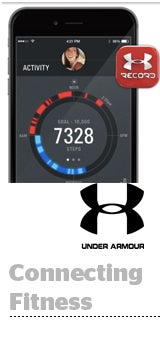
 Under Armour has muscled up since its origin as a supplier of compression tees, thanks to its work connecting channels like mobile and email to physical stores.
Under Armour is now more than an apparel provider.
One of its biggest data assets comes from its community Connected Fitness, which has grown 30% year over year and is now 140 million users strong, with members voluntarily logging more than 1 billion workouts and 5 billion food items into its mobile apps.
And this focus on connectivity is one of the reasons why the former upstart apparel company is second only to Nike now in retail sportswear sales.
“We continue to add 100,000 unique registered users to our platform every day,” said company founder and CEO Kevin Plank during Under Armour’s Q2 earnings call in late July. “Our level and detail of data will empower us to provide actionable insights back to our community to help them lead a healthier lifestyle.”
The beginnings of the Connected Fitness initiative date back to 2013, when Under Armour began investing what would amount to $710 million by acquiring mobile apps including: activity-tracking app MapMyFitness for $150 million, nutrition-tracking platform MyFitnessPal for $475 million and popular European fitness-tracking app Endomondo for $85 million.
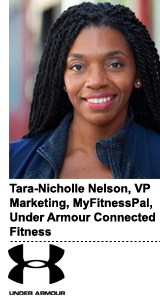
The three apps interconnect with one another (thanks to APIs), said Tara-Nicholle Nelson, VP of marketing for MyFitnessPal and Under Armour Connected Fitness. Nelson noted the three apps’ 140 million unique users are de-duplicated, so the scope is sizable.

That interoperability ensures a steady stream of repeat users – and user data.
“That’s a very common problem with digital health apps – when people download them but don’t use them regularly,” Nelson said, adding the caveat that Under Armour’s data strategy has been “protective” thus far. “We don’t believe we have a business if we don’t protect user data.”
Of course, Under Armour sees the ability of these apps to connect to and expand its primary line of business: selling sports apparel. Right now, the company is in the early innings of integrating all of its mobile acquisitions, but working to link the apps to commerce is in its foreseeable future.
Possible scenario: If a hardcore runner jogs into an Under Amour store with the MyFitnessPal app activated, Under Armour would know the workouts she’s logged and can specify which running shoes would help her reach her goals by triggering a beacon.
Another example: Under Armour could offer a reward or unique merchandise to someone who’s made positive progression with their goals by tracking their race training via a Connected Fitness app.
“Maybe we give you access to gear or an offer you wouldn’t otherwise access unless you were a part of the [Connected Fitness] community,” Nelson suggested.
Until these plans come to fruition – and “when?” is the big question given the bandwidth needed for integrations and the evolving road map of the brand – the retailer wants to engage consumers beyond “the occasional relationship.”
 The brand’s Connected Fitness apps are a big draw for consumers who, naturally, want to augment them within the broader scheme of their daily lives – such as syncing them with their fertility apps or ovulation calendars.
Under Armour’s chairman and CEO alluded that more plans will be revealed around its Connected Fitness efforts at an investor’s day in September.
Fitness apparel is an infrequent purchase, so for more than a year Nelson’s team has worked on a user insights program to decipher fitness habits via ethnographic research, consumer interviews and aggregated app usage data.
The goal was to determine more ways to engage the consumer digitally, and content became a big imperative.
“We were able to determine all of the frictions that stop people from living a healthy lifestyle and wanted to build those insights into messaging for our new content initiative,” she said.
From there, Under Armour looked at its consumer-facing channels and technologies. Although it does not have a traditional CRM, it has a homegrown database of registered users and uses the Adobe Marketing Cloud for things like web analytics.
It also selected Marketo to tailor triggered email content to users of its app in other channels, such as email and owned-and-operated properties.
“We built a standard blog and realized early on that readers were really receptive to email and were voracious for recipe and workout content, so we started sending out a recipe of the day and workout of the week newsletter,” Nelson said.
Using Marketo, MyFitnessPal was able to run a series of tests to determine what titling, phrases, images and timing engaged the most users through its blog; it grew its readership to 10 million monthly uniques and is adding audience at a rate of 7 million-8 million per month.
It reported a 22% increase in engagement on MyFitnessPal as a result of customizing email and site content.
Under Armour is in the process of rolling out original content on Endomondo and other properties to keep engaged consumers engaged in its communities and apps.