
Brands launching campaigns in response to the COVID-19 crisis must tread carefully.
Consumers largely don’t want to hear about irrelevant products or buy nonessential items during a recession. They can also see right through brands with COVID-19 responses that don’t offer something relevant.
That leaves brands balancing the need to distribute important information without coming off as opportunistic in a crisis to avoid a coronavirus marketing fail.
“A marketer has to ask, ‘Am I simply acknowledging there’s a global pandemic and putting my logo at the end, or am I actually adding anything useful to this equation?’” said Chris Sojka, chief creative officer and co-founder of independent agency Madwell.
Know your place
Home security brand ADT is an essential business, so launching a response campaign to COVID-19 was a no-brainer.
“Suddenly we have this renewed sense of relevancy, because people are spending time at home and they want to feel protected,” said VP of marketing Shannon Hendrickson.
But ADT didn’t want to appear tone-deaf or opportunistic. After conducting some quick market research, the brand’s in-house team created a video explaining how its mission to protect the home is now more important than ever, along with a Facebook Group with resources for people stuck at home.

“We’re providing promo codes, delivery services and different virtual activities, like virtual zoo visits,” Hendrickson said.
Real estate firm Coldwell Banker was supposed to tie its first rebrand in 40 years to March Madness, but had to quickly pivot the campaign’s media and message when the tournament was canceled. Like ADT, Coldwell has a strong brand related to home ownership, and fortunately its initial TV spot addressed that in an emotional way, said Coldwell Banker CMO David Marine.
But the brand had to change the campaign’s focus on its history as a trusted real estate agent into a plea to encourage staying at home by highlighting local heroes and swapping out the call to action at the end with a PSA. It also launched a companion campaign on social, allowing its network of 95,000 real estate agents to highlight heroes in their communities, from doctors to grocery store workers.
“We’re providing something of value at this moment,” Marine said. “That’s what made us comfortable  delivering this message at this time.”
Human resources platform TriNet, which services 18,000 small businesses in the United States, had an important message to share with its customers about how it can help them build liquidity, navigate government loan programs and continue supporting their staff.
So it put together a TV spot featuring small business owners photographed by Annie Leibovitz from a previous campaign, and it created a resource hub on its website to help businesses navigate health care options and tax incentives, apply for government loans and make staffing decisions.
“A lot of it is very complicated,” said TriNet CMO Michael Mendenhall. “We want to get them to the source right away and come up with a plan that best accommodates them.”
Big consumer brands are also adapting their messages to the times. Madwell worked with Verizon’s prepaid cell phone carrier Visible on a campaign to showcase acts of kindness while reminding people they can still access low-cost cellular service. And Kimberly-Clark’s Cottonelle created a spot to inform people that there is not a toilet paper shortage, and that it’s working with United Way to deliver toilet paper to those in need.
“A lot of advertisers are trying to run hope and prayers ads around tragedies, and I think people are starting to get sick of that,” Sojka said. “That seems like a cheap way of staying top of mind.”
Avoid the hard sell
Brands are being careful to avoid salesy messaging and strong calls to action for their products.
“You’re either doing good or you’re selling product,” Sojka said. “Don’t try to make doing good sell your product.”
The core objective for ADT’s COVID-19 response campaign, for example, was timeliness to market. “We would never reference COVID and then have a hard direct-response message,” Hendrickson said.
TriNet is also avoiding the hard sell by targeting its campaign to customers rather than prospects. “Our goal is to give advice and choices,” Mendenhall said. “There’s no offer.”
But simply avoiding a call to action isn’t enough. Brands responding to COVID-19 also must live the values they put forth in their campaigns.
TriNet, for instance, is covering health care plans for doctors and nurses who have been furloughed and waiving its professional services fee for medical personnel helping in crisis hot spots. It’s also hosting weekly webinars with business owners to answer their most pressing questions.
Coldwell Banker is helping its real estate agents connect with home buyers virtually through FaceTime walk-throughs. And ADT started a zero dollar down program for its security systems and stopped all door-to-door sales to accommodate social distancing.
“It does feel opportunistic when brands are just like, ‘We’re stuck at home but you can still get our product,’” Sojka said.
Staying cash-conscious
During an economic crisis, brands must take their own financial situations into account. That means spending on media that’s well-priced and attributable.
As streaming explodes, brands including TurboTax, Mazda and McDonald’s have run COVID-19 response campaigns on OTT, which offers reach along with measurability.
ADT, TriNet and Coldwell are all gravitating toward cable news as people tune in for daily press briefings. TriNet is taking a local approach, focusing on regions with big cities where most of its customers reside.
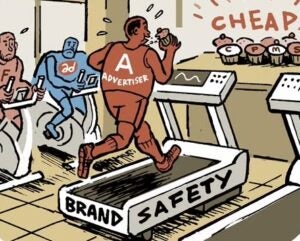
Social has also been an effective way to reach people broadly while allowing them to participate in campaigns. With CPMs dropping while traffic increases, it’s also a good place to hunt for bargains. CPMs were down roughly 20% on Facebook and 22% on Instagram in March, according to buying platform 4C Insights, while messaging was up 50% in regions hardest hit by the virus during the same period.
Brands have also been shifting money to paid search as search activity changes in response to the crisis. TriNet, for example, bought new terms such as “business resiliency” and “business continuity.”
But brands looking to measure success using normal attribution metrics such as sales will have to factor the state of the market and relevance of their products into results.
“For a moment they should cease to evaluate, ‘Is our share of voice exceeding anyone else?’ and ask, ‘Do we have a purpose to advertise?’” Sojka said.