

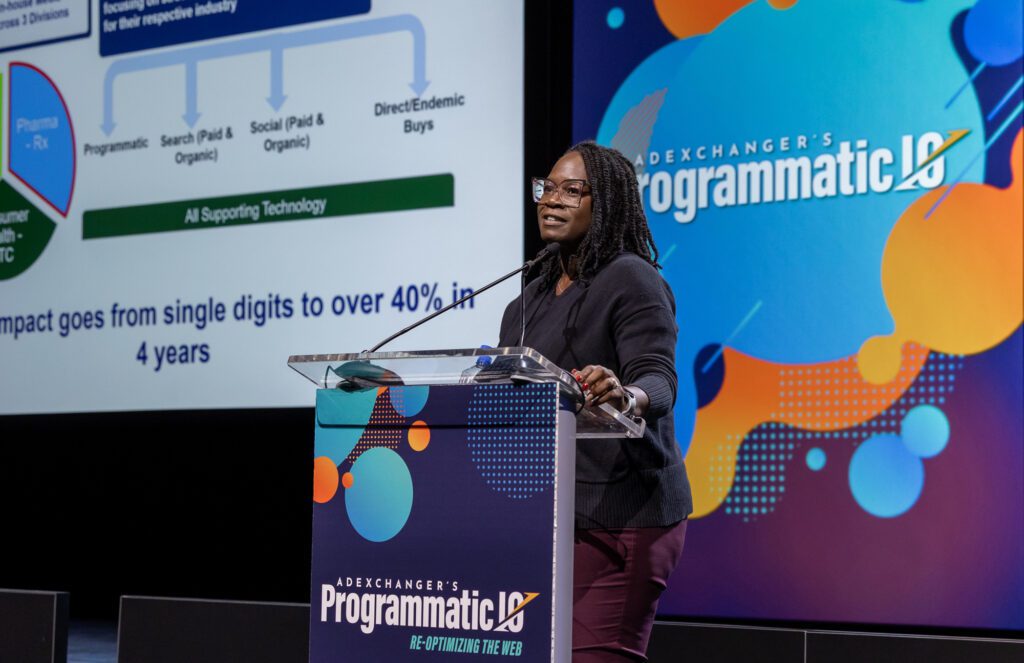
Bringing media buying in-house is “chaotic and disruptive” – but totally worth it, according to Glenniss Richards, Bayer’s senior director of digital media.
Richards spearheaded the in-housing effort for Bayer’s US pharmaceutical division, which took just under two years to complete.
But now that the entire shebang is in-house – including programmatic, search and social (both paid and organic) and all direct and endemic buys – digital marketing is having a palpably bigger impact on sales, Richards told the crowd at AdExchanger’s Programmatic IO event in New York City earlier this week.
Digital’s measurable contribution to sales impact went from less than 10% to more than 40% within the four years since the in-housing project began, she said.
How did Richards and her team do it?

Standing on the shoulders of (pharma) giants
First, it was important to get buy-in from the C-suite and set expectations that everything probably (definitely) wouldn’t go perfectly. Mistakes would be made, and that’s okay, because mistakes are part of the learning process.
Bayer’s leadership understood that, and they were patient with the process, Richards said.
“So you advertised a women’s health care brand to men? Big deal,” she said. “We caught it, learned from it and adjusted our practices quickly.”
Richards also learned from other divisions within Bayer that in-housed their media capabilities. The consumer health group, for instance, first started flirting with in-housing back in 2017.
The pharma folks tapped into the consumer unit’s experience and took advantage of certain components that were already in place. “We stood on their shoulders,” Richards said.
But “there’s no blueprint for in-housing,” she added. “We all went about our in-housing journey in different styles.”
Second opinion
The consumer health group, for example, took a slow and more incremental approach to in-housing.
It partnered with data and digital media consultancy MightyHive in 2018, which has a strong relationship with Google, to gradually transition its media planning, buying, execution and analysis in-house over the course of two years. Bayer used that time to staff up and train new data analysts, technologists and media strategists.
But the pharma division went full bore and brought all of its digital media channels in-house at once – and also put every platform, partnership and contract under the microscope.
Some partners were found lacking.
“We looked at our ad server,” Richards said. “We challenged Google, identified our needs for ad serving and saw that Google just wasn’t it. It was very rigid.”
And so the pharma group pulled all of its media activation for real-time ad serving from Google and moved it over to Innovid, which is now owned by Mediaocean.
At the same time, Richards and her crew stood up their customer data platform while simultaneously managing the agency relationship and hiring new people to support in-house planning and buying.
Meanwhile, they ran pilot tests for all of their data partners – 10 at once – to find the right ones for each individual brand within the pharma portfolio.
This caused “a significant amount of disruption” among Bayer’s partners, Richards said, but it was worth it to end up with a shorter list of vendors that could better support the company’s specific needs.
“Bayer doesn’t take off the shelf,” Richards said. “We prefer custom modeled audiences across our pharmaceutical brands.”
Side effects include efficiency
These days, Bayer’s pharma division works with just two or three data partners and a single demand-side platform – down from three DSPs in the past.
Without having to rely on linear TV for scale, brands in Bayer’s pharmaceutical division are now able to reach up to 70% of their target audiences programmatically, roughly doubling their previous reach, Richards said.
Bayer can also be nimble now, she said. Campaigns are going live roughly 60% faster than before.
“[And] we’re doing it with just one integrated team managing it,” Richards said, “as well as just one preferred DSP.”







