 Xaxis, WPP’s programmatic media company, is a bit of lightning rod in the advertising industry for a few well-documented reasons.
However, it’s undeniable that the ad net/trading desk/tech shop combo invests a lot into its own data, partnerships and technologies. Consider, for instance, the $25 million it put into its proprietary data management platform Turbine in mid-2014. Or the $25 million stake WPP poured into AppNexus, which granted Xaxis the former’s ad server, Open Adstream.
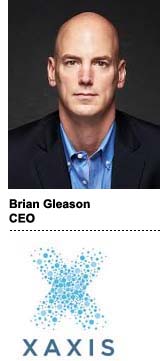
Since then, Xaxis’ then-global CEO Brian Lesser has moved to oversee GroupM’s North America business, and Brian Gleason, who used to oversee Xaxis North America, now heads the entire unit.
“We’re often stacked against Rocket Fuel, Quantcast and Tremor – as we should be,” Gleason said.
Following a year when Xaxis saw its global headcount swell to 1,200 and its overall billings to $1 billion, Gleason said the tech investments will continue: Xaxis plans to pump $54 million back into its platform.
The areas of focus will be on building out capabilities around performance-driven advertising – for instance, the ability to push proprietary algorithms into the demand-side platforms (DSPs) that allow it.
Xaxis is also investing in data integrations and the ability to drive its audiences – usually via Turbine – across more media platforms, including YouTube, a deal it signed only about a week ago. “We’re still working out the details of the arrangement, but YouTube is an incredibly valuable inventory source,” Gleason said.
The third major effort is behind mobile, where Xaxis is staffing up. It brought in former IPONWEB and PubMatic exec Bob Walczak to oversee Light Reaction, a relatively new division focused on mobile programmatic performance advertising. Gleason noted Xaxis’ mobile business grew 300% last year and he hopes to keep that up.
The WPP unit also has hired, but hasn’t yet announced, a CTO.
Gleason spoke to AdExchanger.

AdExchanger: How exactly does Xaxis fit in with the other GroupM agencies?
BRIAN GLEASON: Our business outside of GroupM was a little over $100 million. Those are direct with clients or with independent agencies.
With GroupM agencies, we’re an extension of their teams. If they want audience planning, creation or execution, Xaxis is an available service platform.
GroupM has a new initiative called Connect – a transparent trading desk. Does Xaxis have a role at all?
That’s a transparent trading model service that delivers everything from search to the PBU, the programmatic buying unit.
If clients choose to opt in to access our inventory or products – say they want a transparent relationship on technology and fees, but see benefit from Xaxis media – they can access that inventory. It would be a choice they make.
So GroupM Connect can access Xaxis inventory. Do buyers see the price?
GroupM Connect is completely disclosed. But if the buyer wants to buy Xaxis media for $1 and opts in, signing a paper saying they want to access Xaxis or add Turbine segments – and it would never happen without signing and the buyer knowing that we might be taking a margin – they would see Xaxis at $1. They would see our price, but they wouldn’t see if there was margin or technology costs built into it.
They wouldn’t have an understanding of how much of our data goes into that inventory or how much we paid. We can’t disclose that because we buy all that inventory at scale for the rest of the year, and we can’t break it out.
Let’s talk walled gardens: How do they affect Xaxis?
We’re in a unique position where we can work with multiple platforms, be it Google, AppNexus, Facebook or others. Our goal is to work with our clients’ data to go on top of any inventory.
Could we argue Xaxis itself is sort of a walled garden?
It would be walled outside of our clients, yes. You can’t use our data without being a Xaxis client.
When I think of walled gardens, I think of a situation where I can add data, but can’t take any out.
We’re an activation tool. Normally, a client will use Xaxis to activate across all the different platforms. In a walled garden, you can’t use data beyond the platform. We take clients’ data and amplify it across different vendors, regardless of the DSP. Roku, Videology, the Trade Desk – you can use your segments across all of that. Our goal is to bring audiences across all media – to make the world flat.
How does your relationship with Facebook’s walled garden work? Are you like a client like Procter & Gamble might be a client?
To them, we’re a client looking to access their inventory. We’re an activation engine for 2,800 brands globally. We’re selective in our publisher relationships because want a fraud-free, viewable environment.
How about Amazon?
No. We have a limited relationship with Amazon.
What do you think about Verizon? Now that it’s a player with the AOL acquisition, does that change the relationship you have with it?
We start with two basic questions: Do they have inventory and data attractive to our brands? If yes, that’s a relationship we want to have. The AOL/Verizon story is a good one and we want to continue the relationship.
Does the growing presence of the telcos impact you at all? Obviously, they represent new potential partners and data sets, but anything else?
As long as they remain an open environment, rather than creating another walled garden, then the combination of those assets are valuable to our brands. As soon as they put a wall up, saying you can only buy on our platform and data, then it becomes limiting.
Everyone starts out open, then they close up once they get powerful. Is it realistic to expect that walls will remain down?
We all have to think from a media company perspective: What is the package we’re offering and how is it valuable? For instance, Xaxis Politics uses first-party data, data integrations we have, which we put on top of Turbine segments. That’s placed on proprietary inventory. There are different ways to access that inventory – whether through DSP or I/O.
Speaking of politics, there’s a data free-for-all when a presidential candidate drops out. Are you guys ever in the mix for those assets?
This is our first year playing in the space. We haven’t had much experience with what you mentioned. We haven’t reached that critical tipping point scale yet.