
Here’s today’s AdExchanger.com news round-up… Want it by email? Sign up here.
Take It To The Max
Google’s Performance Max is a black box that uses automation to serve ads across the Google portfolio, and there’s no arguing that it’s a powerful tool. But PMax also invites tinfoil hat theories about how Google might be serving its own interests by obscuring where exactly an advertiser’s budget is going.
For instance, does PMax push advertisers to YouTube Shorts because of the ROAS … or because Shorts is a priority for Google? And what about claiming credit? PMax could be retargeting site visitors and branded search queries to scoop easy conversions that would have been organic sales.
The latest example is a change to Google’s search redundancy recommendations. Over the past couple of years, Google has collapsed some of the controls it previously offered for search campaigns.
The trend has been toward broader controls that allow Google’s machine learning to make decisions. Starting Jan. 19, Google will go even broader by recommending that advertisers remove far more terms and set wider search parameters at a keyword level.
The controversy is that although PMax bids aggressively on branded search terms – when someone Googles a brand’s name, it’s a strong conversion signal – it previously had to defer to advertisers with an exact keyword match. The new search recommendations, however, will greatly reduce exact keyword matches, calling them “redundant.”

Podcasting The Line
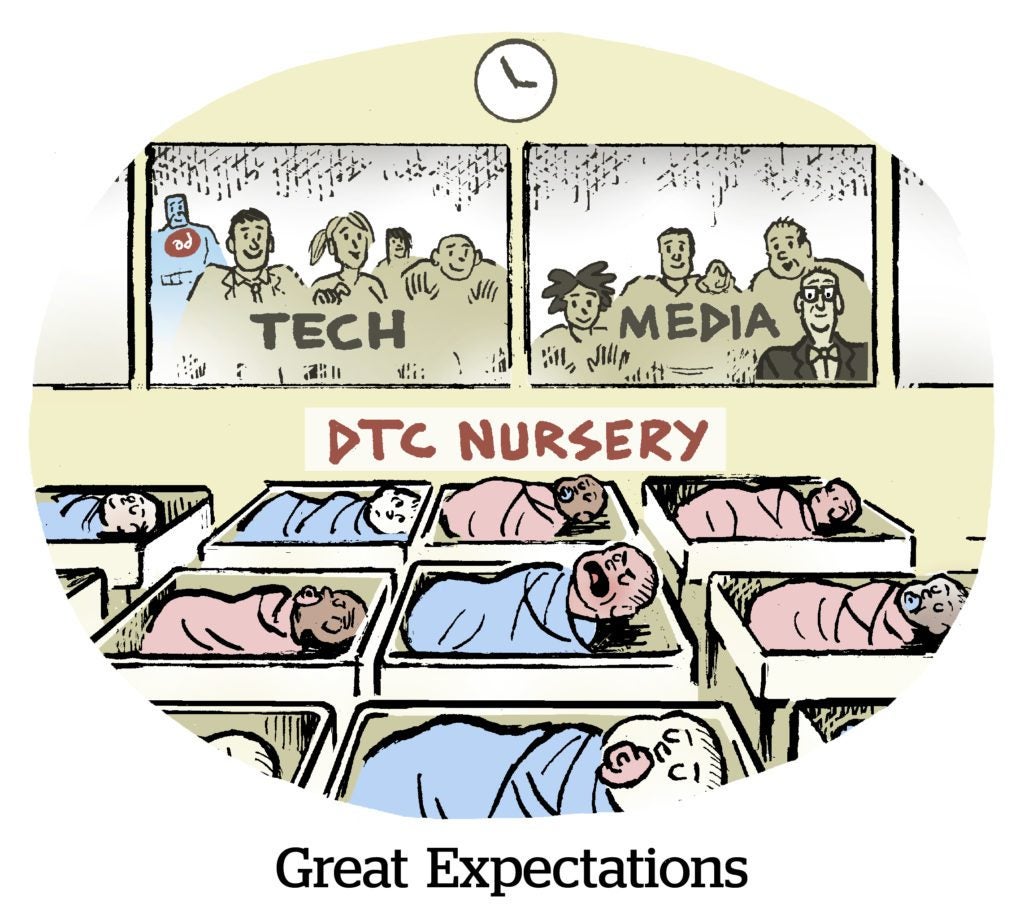
DTC brands have become a pillar of podcast advertising, but some agencies aren’t optimistic that they’ll stick around.
“Long-term brands that have been in the space for three to five years are starting to see diminishing returns,” Glenn Rubenstein, CEO of podcast agency Adopter Media, tells Marketing Brew.
Fortunately for podcast producers, the retail and financial services sectors look ready to fill a potential vacuum.
According to research from podcast media planning database Magellan AI, retailers spent 136% more on podcast ads from January through October last year compared with 2021, with Macy’s, Amazon and Walmart as the top three advertisers.
The finance vertical, including brands such as Intuit and Capital One, increased spend by roughly 61% over the same time frame.
No doubt that for podcasters looking to monetize, it’s the more the merrier. And some buyers are even still bullish on DTC podcast advertisers.
“I see no signs of DTC brands pulling back,” says Cameron Hendrix, co-founder of Magellan AI.
Let’s Be Upfront
It’s conventional wisdom at this point that the upfront TV ad-buying model is outdated, antiquated and generally on the way out.
Except, maybe not.
To paraphrase Mark Twain, reports of the death of the TV upfront may be greatly exaggerated. Fact is, the revenue and pricing guarantees generated during the upfronts are just too sweet to pass up.
For advertisers, the upfront “is like signing a year-long lease on a home,” rather than paying month to month, quips Digiday senior media editor Tim Peterson in a YouTube video. Traditional TV advertisers, meanwhile, get the equivalent of a rent-controlled apartment, with legacy pricing to match.
To be fair, the inflexibility of year-long commitments may inspire some ad buyers and sellers accustomed to shorter-term investments to put their dollars into digital or other time-limited engagements. In the meantime, though, the upfront isn’t going to be fully transformed until at least 2024.
But Wait, There’s More!
Microsoft eyes a $10 billion bet on ChatGPT. [Semafor]
Google says traffic is not a measure of search quality. [Search Engine Roundtable]
YouTube will begin sharing ad revenue with Shorts creators in February. [Engadget]
How much Netflix can the world absorb? [New Yorker]
Facebook will no longer allow gender-based targeting of teens or targeting based on previous account engagements. [blog]
Amazon is expanding its Buy with Prime service, which brings Prime to third-party sites, to US merchants by January 31. [TechCrunch]
You’re Hired!
Contextual in-game ad tech company AdInMo appoints Yasin Dabhelia as VP of programmatic. [release]
Epsilon brings on Susan Rothwell as CRO. [release]
Hearst TV promotes Michael Rosellini to senior VP of digital services. [Adweek]
Spectrum Reach names Jason Brown as CRO. [release]








