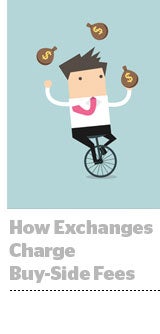
Exchanges, including Rubicon Project, charge publishers a fee for providing access to their ad inventory. But many publishers don’t realize that most supply-side platforms also charge a fee to buyers.
That lack of transparency so incensed The Guardian that it sued Rubicon Project on Tuesday to recover undisclosed buyer fees, as Business Insider first reported and The Guardian confirmed to AdExchanger. Rubicon Project declined to comment for this story.
In addition to charging publishers a fee in the 10 –20% range negotiated with a contract, exchanges will tack on variable buy-side fees before an open exchange bid reaches the publisher.
Typically, SSPs dictate the buy-side fee on an impression-by-impression basis. Due to these fluctuations, it is difficult for publishers and buyers to determine just how much a tech partner is keeping for itself.
“They are like the resort fee of the ad tech world, where they increase your price without telling you,” said Ari Paparo, founder of bidder-as-a-service company Beeswax.
Exactly how Rubicon Project calculates its fees is a mystery.

“We have typically charged buyers a variable price for real-time bidding impressions without specifying the amount or method of determination of the fee that is included in the price,” the company said in its March 10-K filing.
Rival publisher platform PubMatic, which also charges buy-side fees, explained to AdExchanger that it calculates the fees on an impression-by-impression basis depending on several factors.
One factor is bid-stream density, or the number of demand-side platforms (DSPs) competing for an impression, said PubMatic CMO Jeffery Hirsch. If an exchange takes too large of a cut during a highly competitive auction, the buyer could lose and the exchange would end up with nothing, so exchanges are incented to do what’s best for the publisher, Hirsch said.
Exchanges might also vary their fee based on the difference between an advertiser’s bid and the clearing price, PubMatic confirmed. A $10 CPM bid that clears at $2 offers the opportunity to take a larger cut than a $2.25 bid clearing at $2.
Because the exact fee taken with each impression varies, it’s difficult to know just how much an exchange takes. Rubicon Project posted a take rate of around 25% during its most recent earnings report, but averaged it 18.8% when it first went public in 2014.
Publishers paying 15% to Rubicon might reasonably deduce that the company takes another 10% in buy-side fees, given the total take rate of 25%. Or a large publisher may assume its getting a better deal because of its size, and that the exchange makes up the difference by charging smaller customers.
One thing is certain: Exchange fees frustrate buyers, who dislike their lack of transparency. One buyer, Sociomantic, said it’s impossible to definitively determine the fees being charged by exchanges.
“As long as the sum of both the second-highest bid price and any added hidden fees are lower than the initial bid price, there is no way of knowing for certain [what fees are charged],” said Alexander Haardt, a solutions architect at Sociomantic.
One publisher, who asked to remain unnamed in order to protect its relationship with Rubicon, said an easy tactic to figure out how much the exchange takes is to call up a DSP and ask how much they spent with you the previous amount – and then compare that to what Rubicon paid you.
Beeswax’s Paparo, who has sometimes done this type of fee analysis with publishers, said results for each publisher can differ widely. Buyers and publishers can discover fees that range from by-the-books contracted amounts to “enormous” cuts of ad spend, he said.
The publisher source who requested anonymity was generally OK with the fees that exchanges charge. That publisher had negotiated a competitive contract with the exchange for its sell-side fee, and understood the types of buy-side fees charged. He decided Rubicon earns its keep since it boosts publishers’ advertising revenue by building out the technology that runs the auctions, providing a sales force, taking care of billing and paying for fraud filtering.
“There are so many things to do just so a deal looks clean, and someone has to pay for it,” the publisher said. “Our exchange partners eat most of that. I think the lawsuit looks petty.”
Another publisher, Purch, differed.
“I applaud The Guardian in a sense,” said Mike Hannon, Purch VP of yield and revenue optimization. “They felt like the transparency isn’t being honored, and for a publisher to go through and try to uncover this is a difficult task.”
Back in October, The Guardian tested buying its own inventory and discovered that middlemen took up to 70% of what it was paid for an impression. That experiment may have laid the groundwork for its lawsuit.
If pressure builds, exchanges like Rubicon may turn down the dial on their algorithms and lower their take rates. Rubicon leadership has stated repeatedly that it expects take rates to go down over time – even as they’ve risen 6.2% since the company first went public.
Buy-side fees may come under more pressure if other publishers follow The Guardian and file suit against Rubicon.
And there’s yet another factor that could drive down take rates: header bidding. The competition can compress the difference between bid price and clearing price, making it more difficult for exchanges to charge those buy-side fees and still win impressions for buyers.
“Exchanges are going to take as much as possible when they can get away with it, and as little as possible when they are under scrutiny,” Paparo said.