Server-Side Story
Apple blocked ID resolution vendors in Safari, and now the industry is asking itself: What if we just … weren’t in the browser?
Digiday reports that ID5 is moving more of its identity infrastructure server-side. Others are rallying around the IAB Tech Lab’s Trusted Server Framework, which runs ad functions outside web browsers, using publisher-controlled infrastructure instead.
“There’s nothing the device can do to block you,” ID5 CEO Mathieu Roche tells Digiday, adding that large publishers could reroute identity calls from third-party domains in the browser to their own servers in a matter of days.
There’s a catch, of course. Smaller publishers that outsource their ad ops may have a tougher time making that move, and those without in-house engineers could also struggle with the added infrastructure costs.
As AdExchanger first reported, iOS 27 blocks the domains of data and identity vendors, including LiveRamp, Permutive, Audigent and ID5, as well as Unified ID 2.0.
Some blocked vendors, including Permutive, quickly spun up new domains that weren’t on Apple’s blocklist, but that’s only a temporary Band-Aid. Going server-side is a more durable fix.
Still, skeptics wonder if Apple will see the server-side shift as a privacy solution or as a dodge. If it’s the latter, cue yet another round of cat-and-mouse.
Let The Web Die
“The internet must be put out of its misery,” Miles Klee writes at Wired. Although, he notes, evidence is piling up that the internet we once loved is already dead.
Just this month, Google and Meta were hit with massive penalties for violating user privacy. Governments around the world are banning kids from social media due to fears of its harmful effects. Last December, “rage bait” was selected as the word of the year by Oxford University Press. And generative AI is “a turbocharged slop engine for the web,” Klee writes.
Meanwhile, “dead internet theory,” which posits that the web is being taken over by bots and bot-generated content, hardly seems like a theory anymore. That’s the very future many tech companies are building, one where AI agents talk to each other and everyone gets their own personalized, endless content feed.
Things didn’t used to be like this. But there’s a reason the phrase “the internet is a store but it used to be a library” went viral last month. And advertising has contributed to the vibe shift.
Take, for instance, an anecdote told to Klee by journalist John West, who’s promoting his new book, “The Internet Will Die, and So Will You.” Back when he was a kid, West operated an AOL-hosted blog where he wrote about anime. He’d love to delete that blog, but he can no longer access his AOL account. So the site lives on as a zombie page that hasn’t been updated in decades – and it still runs ads.
The Price Is Personal
Some personalized targeting is a little too personal – at least according to the Federal Trade Commission.
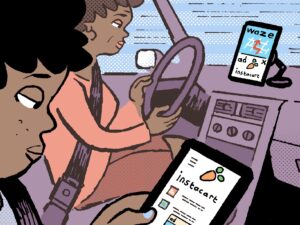
On Wednesday, the FTC launched an inquiry into nine companies spanning airlines, rideshare apps and food delivery services, ordering them to provide detailed information regarding how they use consumer data to set prices and compensation.
The companies on the receiving end of the order are Delta, United, JetBlue, Lyft, Uber, DoorDash, Instacart, Target and Walmart. They have 45 days from when they received the order to respond.
Rideshare and delivery apps may use what the FTC calls “opaque formulas” to set driver pay, possibly factoring in personal data like phone usage and whether a driver declined earlier ride or delivery requests.
Consumers, meanwhile, are often charged different prices for the same products or services based on what a company knows about their preferences.
People “deserve to know whether companies use their web surfing habits or other personal data to estimate the highest price they can charge each consumer,” says FTC Chairman Andrew Ferguson.
So go ahead and mindlessly click “accept all cookies,” but just know that the ones you order for delivery might end up costing you more.
But Wait! There’s More!
Businesses in the UK and EU can opt out of Meta’s new terms of use, which would otherwise permit Meta to train its AI on their content. [404 Media]
A week after Meta apologized for suspending a “No Kings” Instagram account while the group was organizing a protest, Meta is under fire for banning a Democratic candidate’s page in the runup to a key get-out-the-vote rally. [Newsweek]
Why won’t Google’s AI tell you outright who won the 2020 US presidential election? [Ars Technica]
Ohio Republican gubernatorial candidate Vivek Ramaswamy’s controversial ad featuring his opponent’s estranged mother was created by Ohio-based advertising firm Strategy Group, which was embroiled in another controversy last year over its no-bid contract for a $220 million Department of Homeland Security ad campaign. [The New Republic]
You’re Hired!
“Social-first creator agency” NewGen appoints Jordan Carroll as its chief AI officer. [release]