Ask And You Might Receive
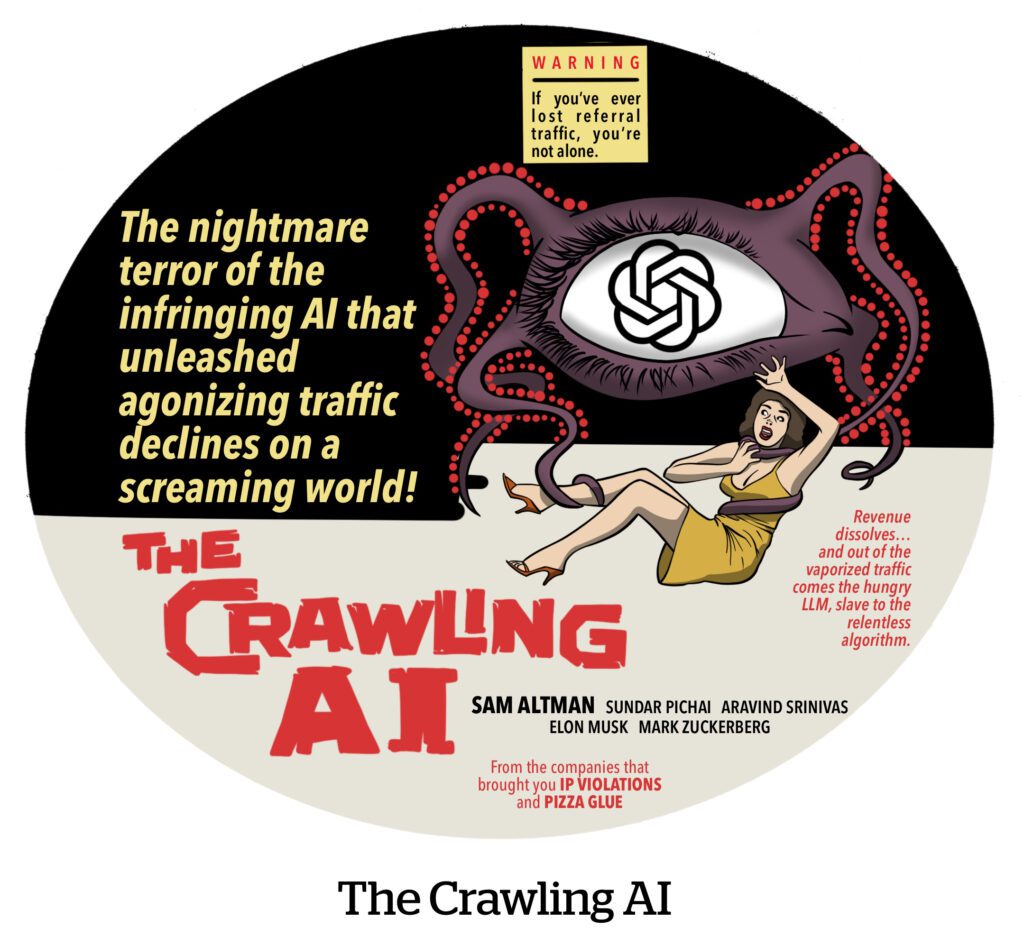
Publishers have been asking (and asking … and asking …) to be paid when their content is cited by AI.
It’s been an uphill battle – but not without some wins.
Earlier this year, Google launched a pilot program for a pay-per-value licensing scheme.
It’s not a clearly defined metric, but the idea is that it gives more weight (and thus more money) to websites whose content has the biggest impact on the answers supplied by AI Overviews, AI Mode and Gemini.
So far, the payouts have varied widely.
One publisher, an early member of the program, is earning more than $1 million annually, The Information reports, while another claims to have earned between $50,000 and $60,000 over several months. Some smaller sites have earned less than $1,000 over a similar period, according to people familiar with the matter.
That range of payouts raises a basic question: What exactly is Google actually rewarding?
According to The Information, some participants “don’t know how their payments are calculated, including what counts as a meaningful contribution,” and also note that the amounts “can change from month to month without explanation.”
Twitch, Please
Twitch’s latest AI tool could revive an old brand-safety problem: flagging content without understanding its context.
It’s not exactly news that keyword blocklists often have too wide of a scope. Email inboxes can “blow up,” for example, and a singer might “bomb” a performance, and neither signals a brand safety issue.
That’s the sort of context Twitch’s AI will have to understand.
Twitch was already using AI to transcribe everything streamers say in their videos. Now, as Aftermath reports, it’s also using AI to determine whether those videos are brand safe. Videos deemed unsafe could lose ad inventory.
In a recent episode of the Snarketing Podcast, Twitch CEO Dan Clancy says that the platform labels content topics with “over 99% consistency,” which ensures that brands don’t appear against videos that don’t match their overall strategy.
But streamers worry that the AI won’t understand nuances, such as sarcasm and more complex context, and that Twitch might leave them in the dark about why they got flagged.
One streamer said that her ad revenue decreases when she uses queer-related tags, like the word “lesbian,” and she’s concerned that the AI will flag any time she alludes to her own identity.
Plus, as writer, speaker and content creator Steven Spohn puts it, most streamers he knows “sanitize and go brand-friendly” when they need to for sponsored streams, but will act like “a goofball” the rest of the time.
As he put it: “We don’t need AI ratting us out to Daddy when we tell too many dick jokes on our own time.”
Theatrical Review
Reviews are crucial to ecommerce sales, making them a tempting target for manipulation. Companies skirt the lines by incentivizing good reviews and/or deleting bad ones, even illegally saddling rivals with poor reviews.
But as LLMs answer more shopper-related prompts, AI models lean on reviews to differentiate products and establish validity. And reviews are making their way into ads, too.
This week, Amazon introduced “Request Reviews for Sponsored Ads,” which are paid placements with calls to action to leave reviews after a purchase. And Microsoft Advertising is testing whether even a snippet of a customer review can generate sponsored search ad sales, as Search Engine Roundtable reports. Meanwhile, Bing is leaning on customer reviews from Trustpilot.
So, what’s the problem?
Well, consider the ad for Best Buy, which was spotted in the wild above a search for “best buy,” and included this snippet from a customer review: “They worked efficiently and swiftly.”
It’s a weird one. Not only was Best Buy advertising on a search for its own name, the snippet gives no clue whether the review is about Geek Squad (which Best Buy owns) or another service – or why it’s relevant to the search.
Regardless, in other news, Google has quietly closed down access to reviews unless users are logged in. Search Engine Roundtable speculates that this tactic is an attempt to wall off valuable reviews data from rival AI models and their data suppliers. Amazon took similar steps this year.
But Wait! There’s More!
DoorDash, as well as Kroger, Giant Eagle and other retailers are trying to train shoppers to integrate agents and AI solutions into their routines. [Modern Retail]
President Trump says that AI executives agreed to a “morally binding” commitment to “tremendous self-policing” after meeting at the White House this week. [CNN]
Instagram launches an AI video editing tool that provides personalized feedback to creators. [TechCrunch]
Airbnb is adding AI search and more social features to its app, because why not? It’s also adding ecommerce integrations with food delivery apps and equipment rental services. [TechCrunch]
Black Twitter is old and busted. Black Threads is the new hotness. [Wired]
McDonald’s wants to use AI to price your Big Mac. Here’s an inside look. [Reuters]
One consumer has had enough of Liberty Mutual’s growing extended universe of silly mascots and the quirky brand mascot trend overall. [Type Click Type]
The Trump administration is using a 1980s anti-drug trafficking program to force cities around the country to feed license plate data from Flock and other providers into a federal database. [404 Media]