
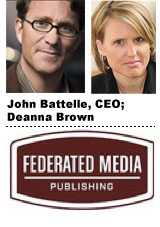
 Just two years after Federated Media Publishing founder John Battelle handed the reigns over to then president Deanna Brown so he could step back as executive chairman, Battelle is taking back the CEO position. In an official blog post, Battelle said that Brown told him that she planned to do something “smaller” and directly involving content creation, as opposed to aggregation.
At the same time, Battelle acknowledged FMP’s challenges. There was a great degree of internal dissension over Brown’s move to emphasize programmatic tools through Lijit, which it acquired a few months after Brown took over in 2011. That decision to shift away from direct, guaranteed ad sales in favor of a more automated process involved a large dismissal of FMP’s ad sales people as part of a wider 10 percent cut in its workforce.

In his blog post, Battelle said doing so was a “difficult but important decision to rethink the company so as to lean into our two most promising lines of business – content marketing (which we lay claim to inventing as “conversational marketing” some seven years ago) and programmatic marketing,” adding that it proved to be the right choice, suggesting that there will not be a reversal any time soon.
Still, as Battelle writes, he’s learned that it’s “OK to change your mind,” though that was in reference to moving back to the CEO seat. As anyone who’s observed the company for the past few years knows, despite taking an oversight role, Battelle has remained an active in the company. At the same time, his concentration has shifted to serving on marketing data services and technology company Acxiom’s board. He’s also been writing a book exploring existing technology and how it may evolve.
Before being hired at FMP four years ago, Brown served as GM of Yahoo Media Group’s Lifestyles business unit. She left in March ’07, joining Scripps Networks Interactive in September ’09. When Battelle brought her in shortly after her stint at Scripps, it seemed he had found the person he was looking for to take on his CEO duties. Instead, Battelle tapped Brown as president/COO and decided that he would hold on to the CEO job after all. But a year passed and Battelle changed his mind back and relinquished day-to-day management as CEO and promoted Brown.
Given that complicated history, it’s hard to know how drastically he will change direction at FMP, which he founded in 2005 as a blog network consisting mostly of tech sites. Over the years, the network has embraced food, parenting, health and fashion sites. Its initial ad model was predicated on the idea of “conversational marketing” or content marketing, as the the industry at large came to call it when social media marketing methods became more mainstream. As the notion of “native advertising” gains traction with newer social media publishers that have adopted FMP’s original ideas and expanded them — e.g., Say Media and BuzzFeed — Battelle probably has a lot of reasons to reverse himself on whether to continue the path Brown chose in favor of relying primarily on programmatic ad selling tools.
Last summer, we asked Battelle to speak to publishers’ collective fears about cannibalizing direct sales with programmatic or real-time bidding. His answer then may offer a glimpse into how he plans to balance direct sales and programmatic going forward.
“There is not yet an elegant combination of creative expression of marketing messaging with the appropriate context and scale inside of content brands,” he said at the time. “Right or wrong, the metaphor that I use a lot is the magazine page. You’ve got a format that is well understood by creators on both sides of the equation… The canvas is known. The canvas is not something that’s in constant question by the bean counters who have to make sure that the ad performs.
“That metaphor does not work in the online space for content right now, mainly because we committed a little too early to a standardized format that was too small. The display boxes and rectangles, it’s not like they don’t do anything but they are not equivalent in terms of return on investment for brands. They work great for some things, but they don’t really work for brands.”








