
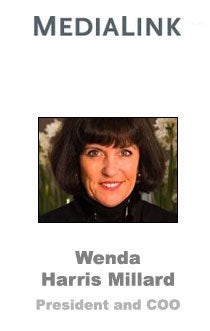
 Once the head of Yahoo’s sales efforts, Wenda Harris Millard is now president and COO of MedialLink, a strategic advisor to media, ad tech, and Fortune 100 companies.
In this interview she talks with AdExchanger about Yahoo’s prospects under Ross Levinsohn, and how her view of exchange-traded media has evolved since her famously divisive “pork bellies” remark of 2008.
AdExchanger: What should Yahoo do now that it’s facing yet another CEO change?
WHM: Yahoo has 700 million users or so, and it’s not shrinking. For people around the world it’s the fabric of their everyday lives. There is fantastic information and entertainment; they’re there because of the content.
The single monetization stream for Yahoo is advertising. Great content, monetized by advertising – that is a winning formula. It’s not the only formula. The reality is this is a media company fueled by technology. The fact that they’ve put Ross in, who understands consumer, content, advertising…is a fantastic move.
To me you have to protect and enhance who you are and what you have. And while it would be fantastic if Yahoo could develop other revenue streams, resources against those revenue streams of any sort can’t outweigh protecting and enhancing your core business.
Many people I’ve spoken with seem to hold Ross Levinsohn in similarly high regard. Can you explain his universal appeal and reputation?
He has brought in deep experience. And he genuinely cares about it. If you don’t have a lot of experience in any given business it’s very hard to truly appreciate it, unless you’ve had operating experience. People really respect him because he understands the business. He’s not playing lip service to it. He is of the industry. And make no mistake, Yahoo is a media company. Just about 100% of its revenue comes from advertising.
He has a tremendous amount of internal support, and that’s very important…from a productivity standpoint. People will do really good work for him, and there’s a lot of optimism about the company’s future given this appointment.

While I have you on the phone, since AdExchanger covers primarily data-driven online ads, I have to ask how your thinking has evolved on this category. Your “pork-bellies” comment in 2008 helped articulate some of the tension at the time between ad exchanges and premium brand advertising. Has anything changed for you?
At the time what we were seeing was an extraordinary decline in CPMs for display advertising. The reason it was very important at that time to send out a clarion call to publishers is it wasn’t that obvious to everyone what was happening and what was going to happen. My comments were really about halting the commoditization for premium publishers.
That was also at a time with ad networks – we didn’t have SSPs at the time – [when] it was really hard to find one of quality. Let me put it that way. They were not working in the best interest of publishers. It was all about commoditizing. It was all about price.
If you look at PubMatic, they are the publisher’s friend. Everyone has excess inventory, but they’re creating real value for the publishers.
The reason that was important at the time was that the ad networks were bottom feeders. Now, four years later, we’ve all matured a lot. We understand the difference between a bottom feeder and an ad network that can add value to what I would call a perishable good. The industry has certainly evolved on that.
If I were to make comments like that today, they would definitely be changed. There would be different kinds of warnings.
What would your new warnings be?
That you have to find ad networks or SSPs that are working in your favor – that they are looking to help you gain a higher price. It’s not about working both sides of the fence, and it’s not about commoditization. It’s about achieving highest possible value for perishable goods – i.e. inventory that won’t be there tomorrow.
The world has evolved. We’re in a much better place, and I’m much more excited about where we’re automating and where we can focus on custom solutions. The automation helps us focus on custom solutions. We don’t need people to do all the work we’re currently doing. Machines are helping us which leaves us other resources for top of the pyramid.
I remember when MediaLink signed on to help MySpace, there was some misperception that you personally would oversee the company’s sales efforts. Do you think people are still confused about what Medialink provides?
That actually was three years ago this summer, when I had just gone into partnership with Michael [Kassan]. The company was not as highly defined, so I think that’s absolutely the case. There was some confusion.
The best way to think about us is as a next generation consulting company. Next generation because the 50-plus of us were all hard-core operators. The senior-most among us have run companies, we’ve fixed companies, we’ve built companies. Everybody here comes from an operating background. Our clients – we’re very biased toward action for them.
We have three customer bases. One is client side. We work for Fortune 100 marketers, and we do everything from organizational structure to executive search, benchmarking, best practices. And then we work for emerging media and ad tech companies, and that’s all about business acceleration – helping them really grow these companies. And then we work with private equity firms. We’re hired as a second set of eyes to work with them on acquisitions and investments.
We are not a sales organization.
By Zach Rodgers








