 Have you noticed? The ad tech, audience buying ecosystem is shrinking. For all the talk about how complicated the ecosystem is and how many companies there still there are, it’s smaller than it was a year or two ago if you look at the number of VC-backed startups in the ad tech space.
I did a quick count of companies that have been bought between 2008 and today and came up with 57 mergers and acquisitions relevant to digital audience buying. And, I’m sure I missed a few.
If you consider the audience buying space as typified by LUMA Partners’ display chart, it’s not just about PC browser-based display – it’s about mobile, video and social channels – even the search channel as search retargeting has emerged as yet another tactic for the digital media, audience buying specialist. I won’t throw addressable TV in their quite yet, but it’s coming (shameless plug!). And hey, you could add radio and digital-out-of-home for that matter to audience buying. But it’s still early with those two, too.
In The Beginning…
I’d suggest the audience buying “Garden of Eden” was in 2007 when Google bought DoubleClick, Yahoo! bought Right Media and Microsoft bought Avenue A/Aquantive and AdECN. Those are the acquisitions that lit the audience buying fires to varying degrees (yes I know retargeting goes back much further.) and aggregated inventory pools for targeting in an exchange-like system.
Here’s my rough list of the ad tech “shrinkage” since late 2008 – around the same time AdExchanger.com began:

- Enliven Marketing/Unicast acquired by DG on 10/2/2008
- Admob acquired by Google on 11/9/09
- Teracent acquired by Google on 11/24/09
- Quattro Wireless acquired by Apple on 1/5/10
- Innovation Interactive acquired by Dentsu on 1/26/10
- Adroit Interactive acquired by MediaMath on 4/16/10
- Consorte Media acquired by AudienceScience on 5/6/10
- Site Scout acquired by Rubicon Project on 5/25/10
- Fetchback acquired by GSI Commerce on 6/1/10
- Invite Media acquired by Google on 6/3/10
- ADISN acquired by CrowdGather on 6/11/10
- Coremetrics acquired by IBM on 6/15/10
- Wunderloop acquired by AudienceScience on 7/5/10
- AdPortal acquired by Glam Media on 7/25/10
- Unica acquired by IBM on 8/15/10
- JovianData acquired by Marketshare Partners on 8/25/10
- 5min acquired by Aol on 9/28/10
- Mobclix acquired 10/1/10 by Velti
- Dapper acquired by Yahoo! on 10/5/10
- BBE acquired by Specific Media on 10/18/10
- Solbright acquired by Operative on 10/18/10
- ScanScout acquired by Tremor Media on 11/8/10
- Jambo Media acquired by Undertone on 11/10/10
- Pictela acquired by Aol on 12/16/10
- ClearSaleing acquired by GSI Commerce on 1/10/11
- Demdex acquired by Adobe on 1/18/11
- TrackSimple acquired by BlueKai on 1/26/11
- Mindset Media acquired by Meebo on 2/8/11
- Adometry acquired by Click Forensics on 3/1/11
- Oggifinogi acquired by Collective on 3/24/11
- GSI Commerce acquired by eBay on 3/28/11
- WebTV Enterprise acquired by Collective on 3/29/11
- Burst Media acquired by Blinkx on 4/8/11
- Greystripe acquired by Valueclick on 4/25/11
- AdBuyer.com acquired by MediaBank on 4/28/11
- Context Optional acquired by Efficient Frontier on 5/4/11
- Revinet acquired by PubMatic on 5/17/11
- Peerset acquired by KIT Digital on 6/9/11
- Admeld acquired by Google on 6/14/11
- Performable acquired by HubSpot on 6/16/11
- MediaMind acquired by DG on 6/16/11
- Tumri acquired by Collective on 7/6/11
- Sprout acquired by InMobi on 8/3/11
- AdXpose acquired by comScore on 8/4/11
- Dotomi acquired by ValueClick on 8/5/11
- AdJug acquired by Dentsu on 8/15/11
- Eyewonder acquired by DG on 8/30/11
- D.A. Consortium acquired by WPP Group on 8/30/11
- OneRiot acquired by Walmart on 9/13/11
- Adotube acquired by Exponential Interactive on 9/13/11
- Ning acquired by Glam Media on 9/21/11
- Datran Media and CONTEXTWEB merge on 9/22/11
- MediaBank and Donovan Data Systems merge on 9/26/11
- Lijit Acquired by Federated Media on 10/4/11
- Auditude Acquired by Adobe on 11/1/11
- Xgraph Acquired by Clearspring on 11/1/11
- interclick Acquired by Yahoo! on 11/1/11
- adParlor bought by Adknowledge on 11/1/11
- Efficient Frontier bought by Adobe 11/30/11
- Panache bought by WPP Group 12/6/11
- Red Aril bought by iCrossing 12/7/11
Dissolved
- Milabra dissolved in 2010/11
- Anchor Intelligence dissolved in 2010
- Feeva dissolved in 2011
- Open Book Video dissolved in 2011
- Ringleader Digital dissolved in 2011
UPDATED 12/7/11
Using AdExchanger.com’s admittedly loose, counting methods, that’s 20 acquisitions in 2010 and 33 acquisitions and mergers already in 2011. More evidence of “shrinkage” momentum, potentially. We’ll see what the fall brings.
Some logos are bigger than other logos
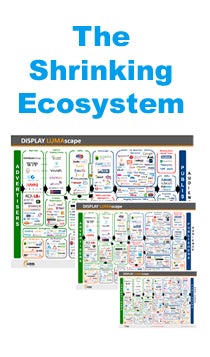
When looking at Terence Kawaja’s LUMA Partners’ chart, I’d make a couple of adjustments when thinking about complexity. (By the way, I’m really glad I don’t have to manage that chart. Terence Kawaja, enjoy!)
First, you can you remove quite a few logos with recent consolidation and as LUMA’s dotted red line shows.
Next, some logos represent marketing stacks – or growing ecosystems unto themselves, if you will. Actually, the ad network/DSP world has many of these types of companies with varying degrees of revenue and capabilities. Consequently, some logos are much bigger than other logos.
Also, some point solutions remain extremely valuable. And some, not so much, as they edge toward oblivion. Again, some logos are bigger than others.
I’ve never bought off on the idea that there are too many companies taking too many pieces of the audience buying pie, etc. This is about re-thinking media. And a lot of people have a lot of good ideas.
But, if it makes you feel better, the ecosystem is shrinking while the number of users (advertisers, agencies, publishers – and still more trading desks/ad networks/DSPs) of the ecosystem continues to increase.
By John Ebbert