 “Marketer’s Note” is a weekly column informing marketers about the rapidly evolving, digital marketing technology ecosystem. It is written by Joanna O’Connell, Director of Research, AdExchanger Research.
As I round out research interviews for my forthcoming State of Programmatic Media report, I had a really interesting conversation with a senior-level operations person at a major agency holding company that struck me as worth sharing.
As with many people on both the agency and client side, he placed high value on the audience targeting that is enabled through programmatic. Yes, check. And he placed low value on “lower CPMs,” wholeheartedly sharing my long-standing point of view that efficiency and cheapness are not synonymous. (If the ROI on $27 CPM impressions is better than the ROI on $.27 CPM impressions, why on earth wouldn’t you just pay the $27 CPM for those impressions? I always thought that de-averaging pricing was one of the coolest benefits of buying media programmatically.) Again, check.
What particularly caught my attention was our discussion around transparency, at which point he noted, “I rank this lower [as a benefit of programmatic] because I don’t want to have to rely on this being the reason I know where I am running. It’s an industry question, not a programmatic question.” This was a view shared by another senior-level agency person to whom I spoke for my research, who, during our discussion on programmatic challenges told me, “There are a lot of people who have a bias against doing things this way and are looking for reasons why they shouldn’t. ‘Transparency’ and all those other things are excuses. It’s more like, ‘This isn’t how I was trained and I am less useful in this world.’”

There are two really important points captured within these comments.
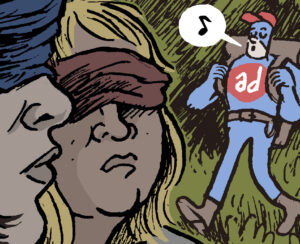
First, while the desire for ”transparency” was a major reason many of us leaned in to programmatic buying in the early days (long, long ago, in the late 2000s) – our collective frustration with blind ad network buying was at an all-time high – the conversation around transparency has begun to shift, to become more sophisticated and nuanced. Is it a ”transparency” discussion when you’re negotiating with a publisher on the parameters of your direct, programmatically enabled deals? Or when you’re fighting fraud issues, or low viewability, in your media programs? Are those programmatic issues, or are they simply industry realities we all must deal with and collectively work to solve?
And second, it points to the continued buyer reticence (whether agency or marketer, as it exists in both camps) to fully engage in programmatic media management for fear of what will happen when they do. This group, as a percentage of total, is shrinking, most I speak to agree, but they’re still out there. Fear of the unknown, often couched in “there’s no transparency,” is still a major obstacle.
I say all this knowing well that these are complex problems that will take time – a lot of it – to work through. And that occasionally, the answer “this isn’t right for me right now” might well be valid. But when someone claims, “There’s not enough transparency in programmatic,” I encourage you to take up the challenge and show them how far we’ve come.
Joanna
Follow Joanna O’Connell (@joannaoconnell ) and AdExchanger (@adexchanger) on Twitter.