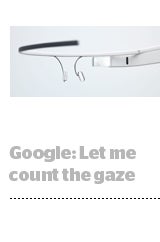
 A new Google patent for a wearable “gaze tracking” technology (US patent #8,510,166) has fantastical implications for how advertising could evolve in a world full of head-mounted interfaces such as, oh, Google Glass. The possibilities include far-out concepts such as billboard viewability reporting and “pay-per-gaze” billing for ads.
In its patent claim, Google describes a method for collecting scene images via a head-mounted device and then performing image recognition at the server level to generate a “gazing log.” This log could be used to “cache” latent search activity for a range of images in a user’s field of vision.
Naturally, in-view images would also include advertising such as out of home and print placements. The patent describes a method for “determining which, if any, of the identified items within the external scenes viewed by the user are advertisements; and charging advertisers associated with the advertisements based at least in part on a per gaze basis.”
There is no reference here to Google Glass, and Google has no plans to implement gaze tracking for Glass in the foreseeable future, according to a source with knowledge of its product plans. Still, what’s described in the patent is clearly intended for some Glass-like device — even if it’s not the Glass we know today.

With the “pay per gaze” concept, an advertiser pays when a consumer sees its billboard or print ad. Here’s the relevant passage.
“Advertisers are charged based upon whether a user actually viewed their advertisement… Pay per gaze advertising need not be limited to on-line advertisements, but rather can be extended to conventional advertisement media including billboards, magazines, newspapers, and other forms of conventional print media. Thus, the gaze tracking system described herein offers a mechanism to track and bill offline advertisements in the manner similar to popular online advertisement schemes. Additional feature of a pay per gaze advertising scheme may include setting billing thresholds or scaling billing fees dependent upon whether the user looked directly at a given advertisement item, viewed the given advertisement item for one or more specified durations, and/or the inferred emotional state of the user while viewing a particular advertisement.”
But the patent’s advertising scope doesn’t end with billing. In a passage sure to be loved by privacy advocates, the filing refers to an “inferred emotional state” of the individual viewing an ad. Trying to shock your target audience? Inspire them? We can tell you if it worked.
“Inferred emotional state information can be provided to an advertiser (perhaps for a premium fee) so that the advertiser can gauge the success of their advertising campaign. For example, if the advertiser desires to generate a shocking advertisement to get noticed or a thought provoking advertisement, then the inferred emotional state information and/or the gazing duration may be valuable metrics to determine the success of the campaign with real-world consumers.”
And here’s more on the reporting implications:
“Any of the metrics gathered by gaze tracking schemes described above may be accumulated across many users to create batched gaze tracking information. Analytical information (e.g., gazing statistics on a per user, per item, per advertisement) may then be generated based upon the batched gaze tracking information and provided to advertisers for a premium fee. The analytical information may be helpful for advertisers to refine and improve their advertisements. For example, advertisers may be interested in which specific advertisements tend to draw and hold a user’sgaze and the type (e.g., emotional gaze) or intensity of their gaze based upon the pupil dilation information.”
Additionally, the relevance to multi-touch attribution is undeniable, though not directly addressed in the patent language. Raw data about ad exposures in physical space, gathered by Google and sold back to advertisers, could be fed into an advertiser’s chosen attribution solution – say Adometry or VisualIQ or Google’s own attribution platform – to more accurately track the ad exposures a consumer encountered on the path to purchase.
The privacy implications of patent #8,510,166 are clearly immense, and would likely be too much for consumers, regulators, and privacy groups to stomach in 2013. But in 2018? Who knows. In any case, Google covers its backside with an obligatory paragraph on anonymity, user opt-outs, and granular controls about who eye tracking data can be shared with.
Contacted by AdExchanger, Google issued this boilerplate statement: “We hold patents on a variety of ideas. Some of those ideas later mature into real products or services, some don’t. Prospective product announcements should not necessarily be inferred from our patents.”