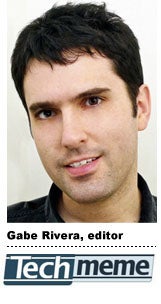
 For the past seven years, Techmeme, the technology news aggregator, has relied heavily on algorithms to help it organize hundreds of breaking reports every day. While it has employed a growing team of editors to sift through and monitor the tweets, emails and other news items that come in from around the tech sector to complement its algorithms, Techmeme founder and editor Gabe Rivera says that no algos direct the company’s ad inventory.
“We don’t use any third party ad networks and we don’t use any ad targeting or tracking,” Rivera told AdExchanger during a Q&A portion of content marketing provider Outbrain‘s monthly Content Conversations Meetup. “All ads that appear on the site at a given time are seen by everyone at once.”

In his interview with Business Insider’s tech tools editor, Steve Kovach, Rivera also discussed the notion of whether content curation is a science or an art. In essence, it’s both. But on the issue of advertising, he’s squarely on the side of art.
For the most part, Techmeme’s audience is fairly transparent: tech journalists and the companies they cover, along with vendors, developers, marketers and venture capitalists, focused on big news in the tech space. (Interestingly, Techmeme has not taken any VC money during its comparatively long history).
As such, there are no standard “click this link” style display ads on the site. Techmeme has maintained the ad strategy it first introduced in 2006: branded blog posts from sponsors, who pay $7k to $17k a month, depending on the position of the post. While those sponsor posts are clearly labeled, Kovich challenged Rivera on the less-than-explicit identification for the paid listings that are included with free ones in the Upcoming Tech Events section. Paid event buys on Techmeme cost a minimum of $3,000.
“You can’t tell which ones they are?” Rivera responded, sounding sincere and surprised. (Hint: paid events are highlighted in a yellowish bisque color). “I think it’s fairly obvious, in the way similar paid results are shown somewhat differently on Google or in eBay.”
After talking about the editorial care put into placing posts from news organizations and bloggers, Rivera noted that there are levels of sophistication even the algorithms can’t accurately understand. Secondly, it helps to be able to vet sponsor messages that are going on the site, though Rivera said he didn’t recall any recent problems with a sponsor post. “To get any of this right, we’ll always need a high degree of the human element,” he said.