Traffiq is among the few companies to cleanly jump the fence from a product-centric to a services-centric model. One year ago, it was focused on developing and marketing a self-service marketing workflow tool. Over time however it became clear prospective customers weren’t ready.
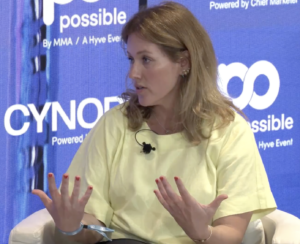
“We were building a model that could be self-serve, and what we found was that they really wanted our services team to do the work for them,” CEO Lori Goldberg tells AdExchanger.
In the below interview, she touches on Traffiq’s current market position, “programmatic premium,” and the evolving role of the digital agency.

What was Traffiq, and what is it today?
LORI GOLDBERG: Traffiq is rooted in technology. We were a technology company that grew into a professional services company, and through that transition we were able to retain our expertise in technology and to seek out the best solutions and partners for our clients. By enhancing our professional services team, we have the ability of a full-service digital agency to look across the entire digital spectrum and recommend what’s best for clients — whether it be display, search, video, social.
I’ve got an entire search team that manages SEO and another search team that manages SEM. I’ve got an entire RTB team. I’ve got an entire display team. All of the stuff we have on our website is actually stuff we do, not stuff we just say we do.
You came from Razorfish. I’m curious how you think the idea of a full-service digital agency has evolved over time?
At Razorfish we were completely innovative in terms of taking on extremely large clients that had complicated data sets and really diving into their business. It was definitely in our DNA, and we had a whole bunch of mathematical geniuses that helped with the odds and ends of campaigns and helped really get us to the next level.
Witinh a company like Traffiq, I’m not going to pretend to ever be Razorfish. We’re not a big, corporate bureaucracy that has multiple different layers and departments. Everybody that works here I’ve pulled out of a large agency so that they have this large-agency experience and can deal with large-agency problems, but within in a more agile environment. One reason clients like us is that we all have that background and that knowledge of what the Razorfishes of the world should be, but can get it done in a quicker, faster, smoother environment.
We treat every client as if they’re a big Razorfish client that Razorfish wouldn’t take on. I wouldn’t in a million years even think that I would compete with them, because we don’t go after the same clients. I’ll take all their remnant clients that they don’t want. I mean, seriously. We’ll take their overflow.
Is there a sweet spot for Traffiq, in terms of verticals or company size or average spend?
We are across all verticals. We’re grounded in retail. We also have clients that are in financial, travel, a lot of universities and hospitals and local businesses, but I wouldn’t say that any one in particular is our sweet spot. I would say that they’re clients that get digital but want to take it to the next level.
Would you describe yourself as a technology sourcing partner for clients?
Yes, I would. We started out on the technology side of the business, so we understand the workflow process, and more importantly, the hiring experience when it comes to analytics and optimization. It’s our job to seek out the technology solutions that work best for our clients, and we’ll continue to do so even if it’s not something we’re building on our own.
How do you feel about preferred vendor relationships? To take the example of DSPs, is it worth the time and resources it would take to test all the players?
We’ve done that. We had a DSP partner that was a preferred vendor. We’ve recently switched, and now our partner is MediaMath.
You may not have time to test all of them, but you should probably look into, have a short list, of ones that you could work with, and then depending on negotiations, contractual agreements, technology [make a decision].
A question on your trading desk. You are not owned by a holding company, so you don’t have to deal with some of the politics that plague trading desks at the holding company level, which can be pretty contentious. And then, clients sometimes see trading desks as a black box. Have you experienced doubt or pushback from clients?
I don’t necessarily agree with that. Although some of the inventory is anonymous, much of it is known, and it’s aggregated into one buy, which simplifies the process for agencies and simplifies the process of sending our fees. I think the trading desk, in general, can increase an agency’s margins, because they allow for agencies to apply performance-based metrics to campaigns, which gives them flexibility to create compensation packages around performance. It definitely gives a breadth of inventory available and, to a certain degree, granularity of data. Agencies can use the trading desk for massive reach and also for needs-targeted campaigns.
Some sophisticated clients want to understand all the idiosyncrasies of the data sources and what each granular level is. Some don’t. They want us to say, “Okay, we’re just putting the Traffiq trading desk as a line-item on our buy, and it’s outperforming the others. That’s all I need to know. Here’s more money towards it, or less, or we have targets for the line-item on the media plan.”
So you offer display media, and then your trading desk is separate from that?
Correct. We just separated it.
Longer term, do the two come together or do they continue to move along separate tracks?
There’s a definite need for guaranteed display buys, as much as there is a need for RTB, and as long as there’s a need for both of them, they need to coexist.
The whole idea of “programmatic premium,” does that resonate with you?
It does. There are pockets of inventory that are extremely important to specific clients. If you’re an advertiser that is targeting diabetes clients, you want to find those people that have diabetes. This is a very simple example. Being able to find that inventory in a programmatic way, but also not basing it on the content that surrounds it in a trusted environment… It’s not an oxymoron having premium programmatic buying.
How many people do you have working in the trading desk business?
That’s a fuzzy question because we’ve got dedicated people and then we’ve also got people that work [across media buying]. Short answer: a dozen.
How many in the company overall?
Twenty-two.
What’s next for Traffiq? What are you growing the agency to become in one year, two years?
We’re definitely looking to expand our retail base. That’s a big focus for us.
One area is looking at online to offline transaction attribution. I think closing the loop…is a direction that a lot of our clients are taking, and we’re helping them with that. We’re also focusing on local and mobile marketing, which aren’t just buzzwords. I can’t answer what’s going to happen in two years, because honestly I hope we haven’t figured it out yet.
Follow Lori Goldberg (@lorigo) and AdExchanger (@adexchanger) on Twitter.