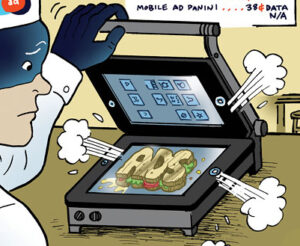
 Xandr’s Relevance Conference in Santa Barbara might be a celebration of data-driven TV’s potential, but legacy business models and competitive interests are preventing advertisers and TV networks from reaching it.
Advertisers want to efficiently reach audiences on digital and OTT channels, but the scale just isn’t there without a cross-network measurement or buying platform.
“Uniformity, or at least cooperation, on the sell side is critical,” said Dave Campanelli, EVP and co-chief investment officer at Horizon Media. “It allows us to get to a point where we’re measuring and buying at scale, which is what many advertisers are looking for.”
Ideally, the networks would work together to develop a common currency that stretches across the entire ecosystem. But the networks aren’t used to collaborating, thanks to years of competition. They’re also worried that a common currency will drive down prices and, because such a currency will extend into digital, cannibalize their high-priced linear inventory.
To be fair, the networks have formed consortiums like Project OAR and OpenAP to solve measurement definition issues. Consolidation has also helped. Joe Hogan, EVP of sales and marketing at WarnerMedia, pointed out that under AT&T, the media conglomerate’s networks consolidated under chairman Bob Greenblatt, giving marketers a simpler access point across all WarnerMedia properties.

But consortiums are still in their infancy, and aren’t specifically about creating a common currency – just addressing smaller issues, like agreement on definitions. Today, advertisers bristle that each content or platform controls how measurement happens.
“On the sell side, there’s an insistence of using currencies and measurement as defined by the platforms,” said Evan Hanlon, chief strategy officer at GroupM. “Advertisers have to become more advanced and think of that as a recipe they put together.
But the networks grumble that advertisers increasingly buy on the “cost-per-whatever marketers have determined are their outputs,” said Peter Naylor, SVP of advertising sales at Hulu. That makes it hard for networks to embrace a common currency to price on.
Whether they like it or not, the sell-side will eventually have to adapt to marketer demands just as they did in programmatic, said Megan Pagliuca, chief data officer at Hearts & Science.
“Publishers adopted programmatic even if they have less control,” she said.
And new advertisers to TV, like technology and direct-to-consumer brands, want more efficient and precise ways to buy and measure ads.
“The way that TV has been bought, sold and transacted is not necessarily the way [these brands] want to engage,” said Ethan Heftman, SVP of ad sales precision and performance at A+E Networks.
Even without measurement, content owners have tried to entice advertisers with innovative ad formats, like pause ads and binge ads on Hulu, which have opened up supply that creates a better user experience on individual networks and platforms. For content owners, these new ad units create “endless opportunities” to open up more supply, Heftman said.
But for buyers, new ad formats feel like putting Band-Aids on a problem the industry created itself by jacking up ad loads on linear TV, which drove audiences to ad-free services.
While both sides are making advancements to make TV more measurable, both sides agree it’s still premature for any breakthrough changes to occur.
“It’s probably early days to say we’re going to be able to move away from what we’ve done historically,” Hanlon said.