Picture the scene: You’re sitting on your sofa watching TV – streaming or, yes, linear TV – and you see the same ad twice in a row. During the next commercial break, you see the same ad again. Then you see two ads for competing brands in the same pod back to back.
It’s an easy scenario to imagine, because who among us hasn’t experienced it? Frequency capping, ad collision and competitive separation are still far from solved problems.
But there is some progress being made.

Can I see some AD-ID, please?
Late last year, the IAB Tech Lab released its Ad Creative ID Framework (ACIF), which creates a standard for a universal ID and a common spec for associated metadata so advertisers and publishers can manage creative assets across multiple platforms and ad registries.
The public comment period on the ACIF validation API, which automates the process of checking whether a creative ID is valid, closed in mid-January.
The Tech Lab worked closely with folks across the industry to develop the framework, including TV networks, TV manufacturers, AVOD and FAST channels, TV-focused ad tech companies and an entity called AD-ID.
AD-ID was founded in 2002 as a joint venture of the 4A’s and the Association of National Advertisers with the mission of devising a digital system for identifying advertising assets.
When AD-ID first launched more than 20 years ago, its focus was on linear TV, but the organization’s purview has expanded alongside the rise of streaming and digital video.
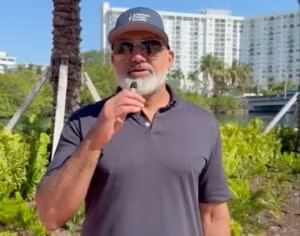
“With the convergence of traditional TV and streaming avenues for distribution, our world is becoming more complex,” said Nada Bradbury, a former Nielsen exec who joined AD-ID as CEO in early 2023. “How can you really be sure an ad is getting placed appropriately and that the right eyeballs are on it unless you’re using a unique ID?”
Bradbury spoke with AdExchanger.
AdExchanger: What exactly is an AD-ID and how does your registry system work?
NADA BRADBURY: The ANA and the 4A’s realized there needed to be more transparency and accountability in the ecosystem. That’s why AD-ID exists.
It’s like a UPC packaging code that should be applied to every piece of creative and carry metadata with it, such as the advertiser’s name, the ad’s length, language and product categorization. There are 12 basic fields, and an advertiser can also include custom fields to share more information about an ad.
We issue the ID, which is an alphanumeric code, and we serve as the registry of these IDs for publishers, advertisers and agencies in the US. There are multiple registries around the globe. The UK has its own, for example, and so does France.
How exactly does the identifier work?
We’re here to make sure that an ad only has one ID associated with it so buyers and sellers can track ad creative through the ecosystem. What this allows them to do is to know the ad placement, to frequency cap, to do ad planning and understand measurement on the backend.
We’re simply here to issue a unique ID and associated metadata with the right taxonomy so that all of this can happen.
It seems to me that the value of something like this is in how many people are actually using it. How ubiquitous is AD-ID?
We’ve been around for more than 20 years, but I joined two years ago to evangelize it. It’s a good system, but it didn’t have the adoption it needed. Today, more than 80% of Fortune 500 advertisers are on board, including Procter & Gamble and Coca-Cola.
Forgive me for asking, but if AD-ID has been at this for more than 20 years, why is frequency capping, for example, still so terrible?
The tools are there, but people don’t talk about it enough because it’s not really sexy, right? Who wants to talk about frequency capping?
We do have adoption, but others aren’t there yet. It’s our job to make people aware that there are already ad IDs available to them that they can use to help with frequency management.
Are measurement companies worried that something like AD-ID could commodify their offerings?
We’ve had conversations with all of the measurement providers, and I think they realize the value. I would say, though, that some measurement companies are more open to working with us than others, because they want to promote new ways to measure.
VideoAmp, for example, is very open, and we’re in the midst of doing a proof of concept with them.
I don’t see any risk here for measurement providers, only benefit. That said, it’s a heavy lift for some of the bigger players in the measurement space to make even a little change to their process, which is one reason some companies have been a little slow.
What about Nielsen, your former employer?
Well, they are a larger company, so, yes, it would be more of an effort for them to adopt this. We’ve been in conversations with them for about a year now. They’re very aware of AD-ID and they’re interested. I just think it’s a question of prioritization.
But as we shed more light and they start to hear about it more from their clients, I think we’ll see something happen, especially as they move more into Nielsen One.
This interview has been lightly edited and condensed.
For more articles featuring Nada Bradbury, click here.