

 AskMen is firmly in the pro-platform camp among publishers. The men’s website, born during the dot-com boom, now looks to platforms, not SEO, as a way to gain audience and increase recognition.
The king of those platforms is Facebook, where video posts earn the publisher millions of views. AskMen, which is owned by Ziff Davis, will also be part of Google AMP and is gunning to be a publisher on Snapchat Discover.
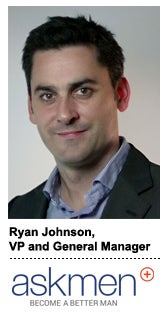
“The wise publisher goes for a pro-platform strategy,” said Ryan Johnson, a VP and general manager at AskMen. “Readers are spending a lot of time in their news feeds, and that requires a change in strategy. Our philosophy is to go where the readers are and deliver the best content to them.”
AdExchanger spoke to Johnson about AskMen’s approach to monetization in a platform-driven world, including how the publisher is addressing ad blocking, viewability and the shift to custom content programs.
AdExchanger: How is AskMen responding as content consumption shifts to platforms?

RYAN JOHNSON: One big success we’ve had is adapting video on our site for Facebook. It’s really resonated. Last week, we had one day with 19 million video views on Facebook. We reached 160 million people last week, according to Facebook Insights.
You aren’t getting any ad revenue from that, correct? Just a brand halo?
Yes, there’s a brand halo, but the conversations with Facebook have been very pro-publisher. They understand that there has to be an ecosystem where publishers can be rewarded for creating their content. There’s also an opportunity to create branded video as well, which I don’t think they’re fully against. It’s not pre-roll, but it’s native Facebook video content.
What other platforms besides Facebook are capturing your attention as a publisher?
I think Snapchat is a huge opportunity, but not to drive traffic to the site. It’s your brand, condensed and reduced to its essence. Snapchat is comfortable with monetization, and it will be monetized in its own right. Google AMP is the gorilla in the room. We’re definitely moving forward with that, that’s just a matter of development work. It’s much more of technical effort.
You started out on the audience development side. What does audience development mean today?
When I started, search was it. Historically, SEO has been a huge part of the traffic mix. Now, it’s moved to this platform model. Audience development moves more in the realm of business development versus article optimization and backlinks. Facebook is by far and away the point of success, but I think it’s important to keep lines of communication open with Facebook, Google, Apple. You roll the dice and set up a feed. We had 1.5 million followers on Pulse, and then it was acquired by LinkedIn.
AskMen has a young male audience, the prime demographic for ad blockers. How are you adapting?
Readers are blocking ads because ads are an invasive unit. It interrupts them from doing something they want to do. What we need to do is be smarter about the user experience on the site and make better choices for the user. My focus going into 2016 will be optimizing the user experience to make ads less invasive. The natural evolution will be to push toward native ads. Brands are supposed to be part of content consumption, not interrupt it.
What’s your advertising focus?
We lead with being storytellers. It comes down to how we integrate a brand story with ours. We just had a campaign for Asics, where we had a content hub on the site, and held four road races in New York with local running clubs and influencers. That makes native advertising feel like it’s on the same playing field as any content we create. We’re looking for a win-win-win for AskMen, the readers and the brand advertisers.
Where does programmatic fit in to your advertising strategy?
We’ll lead with the story we want to tell with the brand. Media will be a part of that proposal, and there’s also the option to buy programmatically. Most of what we do in programmatic is direct, like private marketplaces. Keeping the value of the direct relationships is important. With the new scale outside of AskMen.com we’re building [on platforms], we can extend that conversation outside of the site.
You’re talking about distributing branded content through AskMen’s social networks as a way to scale campaigns. Is that a problem for brands, since it’s not quantifiable the way a 300×250 is?
There’s a new world where you can engage with readers differently. It’s not pre-roll. From an engagement and attention perspective, it’s more powerful because it’s not interrupting. You’re part of something that’s interesting to a user. That economic shift [to quantify that impact] needs to happen.
Where are you on your path to mobile monetization?
We focused this year a lot more on the ad mix to make our site more viewable on desktop and mobile. Our site is also now fully responsive, and we added rich media to our mobile experience. It’s a challenging process, because there can be a trade-off between volume of impressions and viewability. We tried to offset what could be the loss of impressions by adding in new engaging ad units, and a lot of those are on mobile.
In 2016, we’re going to work on greater native app experiences. We launched guyQ, a Q&A engine on AskMen, and that could lend itself to a native app. There’s also a news and conversation channel, Dispatch, which could become an app experience.
What’s it been like selling viewable inventory this year?
We get some demand for viewable ads but there are also challenges in uniform measurability in viewable ads. If you have to compare apples to apples [to bill on viewability] and the brand and publisher are using different platforms where the numbers don’t match up, it’s tough to run a business that way. But brands have been flexible. They understand the limitations of viewability at this point in time, particularly as it pertains to measurability.
Fraud is still a hot topic for advertisers. How do you assure advertisers they’re reaching humans?
We don’t buy traffic, so that’s how we do it. We’re not in the paid acquisition game, and this is Ziff Davis-wide. We believe in generating traffic organically. If we’re working with partners, they are established publishing brands that will drive traffic to our site. We do know there is a huge volume of terrible traffic on the Internet, and not acquiring low-cost traffic is a way to combat against that.








