Rembrand, the virtual product placement startup helmed by ad tech vet Omar Tawakol, and creative automation startup Spaceback share a similar schtick, which is to create ads that don’t look like ads.
Now they’re also going to share one roof.
On Monday, Rembrand announced that it’s merging with Spaceback to build a unified AI-powered platform for “content-based” CTV, digital video and display. Terms of the deal were not disclosed.
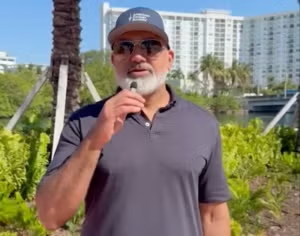
The rationale here is straightforward, Tawakol told AdExchanger. Both companies are “pretty much doing the same thing,” he said. “We’re just approaching it from different angles.”

“People love content, and they hate disruptions, so they’ll literally pay money not to see ads,” Tawakol said. “In that kind of a world, you either need to embed a brand into content – which is what we do – or make great ads out of content, which is what Spaceback does.”
This is Rembrand’s second merger. In July, it acquired the US operations of Mirriad, which uses computer vision to embed brand assets within contextually relevant scenes.
Post haste
Spaceback caught Tawakol’s eye, he said, because of its scale – it works with more than 3,000 mainly mid-tail advertisers – and because of the “simplicity of the idea.”
Rather than using generative AI to construct an ad from scratch or from separate component parts, Spaceback automatically converts preexisting social media content posted by a brand or an influencer into programmatic video, streaming and display ads that maintain the authentic look and feel of the original posts.
People are less likely to ignore – or get annoyed by – ads that look like something they might actually click on organically in their feed.
Spaceback also gives advertisers the option to add interactive elements to their ads, including overlays, animations, dynamic location awareness and QR codes.
And because the platform is easy to use, Tawakol said – advertisers can log in and get going within a few minutes – Rembrand will get access to a larger pool of training data for its algorithms.
“AI loves data,” Tawakol said.
But self-serve also means marketers can jump on trends without having to wait around for their agency or shelling out a bunch of money for a 15- or 30-second spot, he said.
CMOs “want to move at the speed of culture,” Tawakol said, “and if it takes an agency a month to produce something, the culture has already moved on – it’s not waiting for you.”
Go with the workflow
Rembrand is also planning to move fast.
The combined company, which is taking Rembrand’s name, will start integrating the platforms by October, which is when the deal is set to close. The integration should be finished by early next year.
The finished product will be a single platform where advertisers can find content that aligns with their brand, add product placements to it, generate ads from it and activate campaigns, including across CTV, all in one place.
Tawakol highlighted the discovery aspect in particular. It’s a big world of content out there, which can make it hard to pinpoint the specific clips, posts and influencer videos that’ll translate well into strong ad creative.
Rembrand has a system that scans a brand’s website, social handles and videos across platforms like YouTube, TikTok, Instagram and LinkedIn to nail down its vibe, and then sources compatible content.
The new platform will incorporate agentic AI into the discovery process (because of course).
“As soon as we do the integration, we’ll be able to tell advertisers exactly which posts are best for them,” Tawakol said. “And then they’ll be able to do the rest themselves.”
Don’t let the grass grow
Until the integration is finished, Spaceback will operate as its own division under Rembrand.
All employees – just over 50 on Rembrand’s side and 25 Spaceback folks – are staying on, including Casey Saran, Spaceback’s CEO and co-founder. Tawakol will serve as CEO.
In terms of next steps, Tawakol said Rembrand doesn’t technically need to raise more money anytime soon. Spaceback is already profitable and Rembrand, which still has runway from its $23 million Series A earlier this year, could get there without additional funding.
But Rembrand’s growth ambitions will probably win out, Tawakol said.
“I suspect our appetite for expansion will keep us running like a venture-backed company,” he said. “At some point next year, I can see us being open to a Series B. We just won’t be in a position where we have to do it, which is nice.”