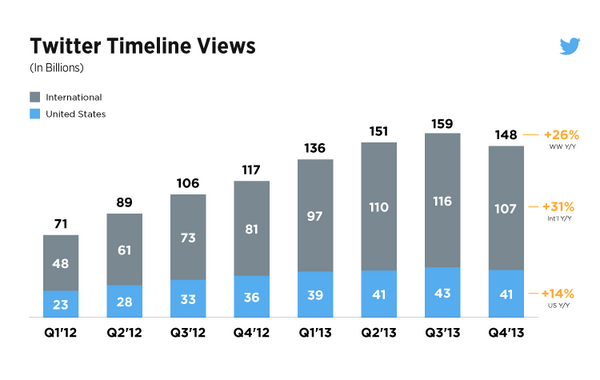
 Twitter’s first quarter as a public company was hot and cold.
Ad performance was the hot part. Q4 2013 ad revenue on the Twitter platform grew 121% to $220 million, of which mobile advertising accounted for more than 75%. The MoPub mobile ad exchange, acquired during the quarter, delivered $8 million in revenue.
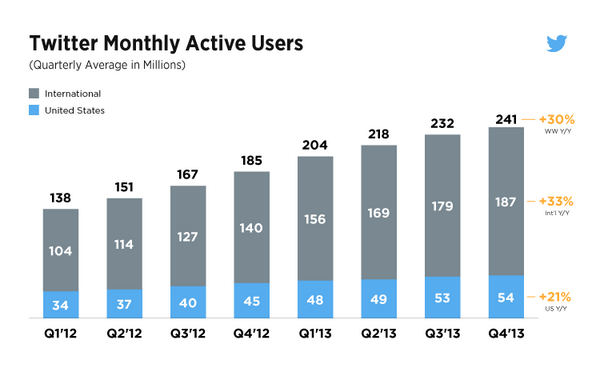
Audience trends are the cold part. Growth in Twitter’s monthly active users slowed significantly to 30%, while timeline views actually shrank sequentially.
“We have massive global awareness of Twitter, and we need to bridge the gap between awareness and deep engagement with the platform,” CEO Dick Costolo told investors. “That is absolutely a focus area for us.”

Twitter, like Facebook before it, began shipping lots of ad features once it became a public company — including CRM matching, retargeting, custom targeting groups and lookalike modeling. In that sense, going public has been good for business.
Most of these changes, and the corresponding improvements in ad revenue per timeline view (see chart below), were achieved without pushing a big lift in ad load, Chief Financial Officer Mike Gupta said. Gupta said during the quarter Twitter drove a “very modest” increase in ad load. “We think we’re low not only on an absolute basis but also relative to others in the industry,” he said.

Additionally, Gupta said Twitter enjoyed strong adoption of the Amplify broadcast partner program. And he said overall ad engagements rose more than 70% quarter-over-quarter, in part thanks to the “Media Forward” initiative to introduce more visual elements to the Timeline.
But with regard to overall engagement, as mentioned above (and reflected in the chart below), Twitter’s Q4 alarmed investors, showing the company’s first-ever sequential decline in the number of timeline views. Management sought to spin that fall-off as a victory for experience design — saying Twitter has seen more engagement where it counts. Favorites and retweets are up, for instance.
However with only 241 million users active on the platform, and a stated ambition to reach “every person on Earth,” Twitter needs to show increases in every metric every quarter.
This, clearly, is unacceptable: