

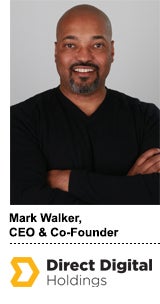
Before co-founding ad tech and mar tech holding group Direct Digital Holdings in 2018, Mark Walker was chief operating officer at Ebony Media.
His experience on the sell side was formative. A big part of Walker’s job was to help Ebony with its digital transformation and transition from print to digital, including programmatic monetization.
Walker quickly realized there was “a hole in the market.”
“We saw that small, midsize companies had difficulty getting connected into the programmatic ecosystem from a lack of resources and expertise,” Walker said. “We saw firsthand that if we didn’t have the name brand of Ebony, we wouldn’t have gotten the attention of SSPs to monetize.”
The idea behind Direct Digital Holdings, which houses a mixture of acquired and homegrown buy- and sell-side tech, is to help midsize publishers access the same opportunities as larger media owners.

In February, Direct Digital Holdings IPO’d on the NASDAQ under the ticker symbol DRCT. The company’s stock popped after its first earnings report last week on strong revenue growth and estimates above guidance. Q4 revenue was up 95% YoY from $6.3 million to $12.9 million, with first-quarter revenue expected to hit between $11 million and $11.5 million, compared with analyst expectations of $8.42 million.
Walker, who’s the company’s co-founder and CEO, spoke with AdExchanger.
AdExchanger: Why house buy-side and sell-side tech under the same roof?
MARK WALKER: There are a lot of tools in the toolbox that you can use to optimize campaign performance if you understand the buyer’s objectives. There are things you can do on the publisher or SSP side to influence that in a positive way, from the positioning of ads on a page to how you rank an ad inside of a stack.
When I was at Ebony, many times, if a campaign didn’t perform, the buyers would just cut it off rather than figure out how to optimize it. With Direct Digital, we’re on both sides of the equation, so we have an opportunity to curate.
In the past, that sort of setup might have been seen as a conflict of interest, but do you think it can be an advantage?
We mainly deal in the mid-market. We have clients in Colorado Springs, Pigeon Forge, Knoxville, Nashville – flyover country. If they spend $1, they want $1.10 or $1.15 or $1.20 back. But how do you get there? They’re actually not too concerned about that.
They just want to make sure they’re getting the end result, and so you don’t see the same kind of channel conflict on the buy side as you might if you were working directly with a large brand.
So, I do think it’s an advantage, but also a missed opportunity. Although, you are starting to see these pieces coming together with Criteo’s purchase of BidSwitch and Tremor’s acquisition of Unruly.
What are all of the different pieces you have in your stack?
On the buy side, we have Huddled Masses and Orange142, which are two companies that operate independently. Both are profitable and have been excellent acquisitions for us. And on the sell side, we have our SSP Colossus, which is proprietary to us. That business has become the growth engine of our company.
There are many other long-established DSPs and SSPs out there. How do you differentiate?
It’s twofold. First, we have our focus on multicultural publishers. We spent a significant amount of time and effort identifying small and midsize publishers that are trying to attract multicultural audiences, which we define as Hispanic American, African American, LGBTQ and Asian American.
We give buyers a one-stop shop to reach that market concentration along with the general market.
We have an affinity for publishers overall and we want to be an advocate for publishers. From having been on that side, I know it’s tough to make money in this space.
The market is a little … weird right now. Why decide to IPO this year?
It’s about accelerating growth. We didn’t have a private equity sponsor, we’re not VC-backed and we bootstrapped this company. My co-founder Keith [Smith] and I are the majority shareholders.
We felt that going public could help us get market credibility, which is very important. To be brutally honest, being a minority-owned company, credibility might not be given to us the same way it’s given to other companies.
But we also wanted access to the public markets to help us raise capital so we can grow fast. We’ll run a shop that’s able to sustain that growth, and we think it’s the right approach, even if Wall Street falls out of love.
Do you plan to deploy any of that capital for more M&A?
I’m not able to make any forward-looking statements – I just learned that tagline.
But, broadly speaking, probably yes. I think it’s safe to say that we have an organic growth strategy we’re very confident in, but if an opportunity presented itself, we definitely would explore.
This interview has been edited and condensed.









