

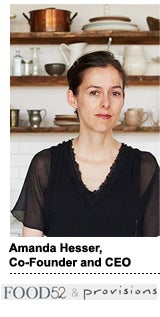
 From the start, foodie site Food52 planned to have two revenue streams: advertising and commerce. Today, commerce drives two-thirds of its revenue, with advertising accounting for the other third.
The site now averages four million unique monthly visitors. After building up content, 98% of which is contributed by readers, Food52 had the audience to add an e-commerce arm. That section, Provisions, went live in August of 2013. That same year, the publisher began selling advertising directly.
The site doesn’t write content that it think will drive sales; instead, it looks for natural fits between the content and products. Below most stories, there is a recommendations module with two links to related content and two links to related products.
“You might come to Food52 for advice on grilling steak, but you might also need a rub for that steak, or a cutting broad, or steak knives to serve it with,” said CEO and co-founder Amanda Hesser. “Those things have been separated from the helpful content. We brought together everything you need and created one place for it.”
The site’s approach is working: 40% of commerce conversions come from a piece of content.
The rest of those sales come from more traditional channels: social, email, affiliate programs, and paid social or search. One and a half million people subscribe to Food52 emails. Affiliates – often smaller food, cooking, and lifestyle sites – together form a network that extends the same principles of marrying content and commerce.
Food52 found its commerce focus put it on the same page with its advertisers.
“Because we have commerce as a big part our brand, we have proof that we can activate our audience. It gives us a huge advantage in the relationship building for advertisers and proof that we understand our audience,” Hesser said.
E-commerce businesses are known for their clean data and easy attribution from ads to sale. Food52 is working on organizing and applying its data for use internally and on behalf of advertisers.
Its entry point into understanding its users better is Collections, a Pinterest-like service that allows users to collect and file their favorite online items. One of Hesser’s collections, “Cocktail Hour,” features a mix of recipes and products, such as whimsical drink stirrers.

This summer, Food52 used information from Collections to make inventory and content decisions. Readers were saving cake recipes and fish recipes at an unusually high rate, so the site added columns addressing those topics and shored up offerings in its Provisions store.
For advertisers, Collections offers the chance to get in front of customers who have expressed interests in products or topics that are relevant to those advertisers. Food52 plans to give advertisers access to this data in 2015.
In addition to the data-sharing plan, Food52 just started a loyalty program that will target its best customers with new products and tie email marketing to a person’s behavior on the site. If someone saves a Provisions item or puts it in his cart, for example, Food52 could follow up with an email offer for free shipping to try to close that sale.
Advertising Mix-Ins
Just as Food52 does not create content just to promote an item in its store, it makes sure sponsored content offers relevant information for its audience. “All the content [in sponsored posts] we would be doing whether or not there was an advertiser,” Hesser said.
For the china company Noritake, for example, the site created a post and video titled “How to Throw a Stress-Free Brunch.” The video “brought together a lot of things. It was a recipe we’ve been wanting to show in a video format, and it uses Provisions items,” Hesser said.
The sponsored posts improve the performance of display advertising buys. The click-through rates for banner ads next to sponsored content are 300% higher, on average, than ads that aren’t contextual.
The site brought a similar spin to an Instagram campaign it did with Annie’s Mac & Cheese. A series of posts brought in a few thousand likes each. The best-performing post, which garnered more than 3,600 likes, featured the boxed pasta with broccoli rabe and sausage mixed in.
For another campaign, the site ran a contest with Bob’s Red Mill that encouraged users to submit their best quinoa recipes. Even a year after the contest ended, the site and the recipes continue to draw strong traffic. “The conversation we’re having with advertisers is about engagement, but it’s also about the fact that it will stay forever,” said Lauren Locke, Food52’s director of sales and partnerships. “Because there’s such content alignment, we’re never going to take it down.”
With content, commerce and advertising so close together, achieving that alignment is paramount. “The most important thing we do is partner with brands that are a good fit for our audience,” Locke said.







