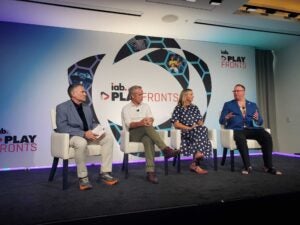
 Like many publishers, The Washington Post’s Kelly Andresen grapples with success metrics for native advertising campaigns.
As director of ad innovations and product strategy, she has a front-row seat on her publication’s digital evolution and oversees teams that are dedicated to creating new digital advertising revenue, including native.
“When you move into content marketing, it’s a whole different conversation than standard display advertising,” Andresen said. “A click-through rate is not going to tell you a story of how well your native campaign performed.”
WaPo’s go-to native product is WP Brand Connect and Q4 of this year will bring its next iteration: a roll-out of the solution in all of the company’s mobile apps. It will build on what Andresen said has been a successful implementation for the company’s desktop and mobile web properties.
Andresen discussed the latest on native at The Washington Post with AdExchanger.
AdExchanger: What’s the biggest challenge in measuring native?
KELLY ANDRESEN: I think our biggest challenge is “How do you define success?” Right now, it’s different for every advertiser since each has different requirements in developing a content marketing campaign.
A metric like time spent on site or video completions might make sense to our advertisers. Or, their goals might be that they just want to get their message out there and raise awareness. So sharing metrics such as “How often did people share this?” and “How often did they ‘like’ it?” are probably much better measures for awareness and engagement.
In the end, it’s about how clients define success and how can we design a program and the metrics that help them understand what happened here and if they made a great investment.

Do you provide success metrics directly to the client? For example, is there an equivalent of third-party ad serving and social tools that they ask you to use on their behalf?
It’s a mix. We do still provide the standard, what I would call “display metrics.” Things like clicks and click-through rates for all of the native units that are embedded across our site. It shows a picture of how people are getting to the content. And, we provide it internally through our ad server.
We also provide a suite of engagement metrics just from us – those are things from Omniture such as page views, time spent on page as well as Moat metrics – looking at hover time, in-view time and scrolling depth. Those are all provided by us – not through third parties.
One of the supposed challenges with native is scaling it. Are you providing a scalable opportunity for native?
At The Washington Post, we believe that native is an opportunity for a brand to tell a story across our platform in the environment that our readers have come to expect.
We can use some outside measures. We have WP Plus, which is our audience extension solution to drive a larger audience to the content or perhaps target those people who have already read the content and have them return.
Is there any movement toward linking your native solutions to conversations that are happening through other channels, whether it’s online or offline?
That’s in the future, but it’s definitely where we want to grow. There’s definitely a movement within the larger media industry about attribution and how you attribute where somebody engaged with the content online, learned about the brand and then that learning drove them in-store.
As an industry that’s something that we all need to collectively work on – attribution – and, certainly, in how it applies to native, which is even more challenging.
So is native primarily a branding opportunity? Does it have equal weight to direct response?
We’ve seen most success in the brand space with brands that are looking to change or shape a conversation and tell a new story about their brand.
What sort of creative do you use in native advertising?
We first launched our native product with text and video and very quickly added additional forms of storytelling through infographics, animated videos, live-action videos, photo galleries. It really comes down to what is the story that the advertiser wants to tell and advising them on what’s the best way to tell that story.
For example, if you have a data-driven campaign about changes in job creation and how it affects the American people, that might be better told in an infographic rather than six paragraphs of text.
Are your editorial colleagues interested in collaborating?
Yes, absolutely. When we first launched our WP Brand Connect native advertising solution, we spent several months meeting internally with all of our partners across the company – with obviously editorial being our No. 1 partner. We learned from them and what would be their concerns, what should be the proper labeling of the product, how we integrate it into an experience that our readers are expecting and make sure that we have the same quality standards as our newsroom.
They continue to provide feedback for us on ways that we can improve and continue to learn from the best in the business about everything from how to write a good headline to how do we maximize social shareability.
Does the benefit work the other way? I’d imagine hover metrics or how a reader interacts with a story might be interesting to them.
We can certainly share that, but haven’t as of yet. You’d be amazed at all the tools and sophistication the newsroom has. They’re very accustomed to having all these tools already about where people are engaging, where are they clicking, heat maps of the page, all in real time. They have amazing sets of data at their fingertips that they can optimize immediately.
That said, it might be interesting to see if they correlate it all – if we see our readers consuming content in the same way that they are consuming editorial content.
In the past year, where has native grown the most?
Two things come to mind. First, the early players in this space have become much more sophisticated. You have those advertisers and brands out there that have a very clear content marketing strategy. Some of them even have their own newsrooms. They have very clear goals and know the metrics they want to achieve to reach those goals. So, it be becomes a very specific conversation for us about how you’re going to create a plan and execute on it.
The second big growth trend is interest. There’s so many more publishers out there that are in this space, which is exciting. It’s really raised the awareness of native as a tool overall, and we have more brands coming to us that are interested in native that weren’t interested in it a year ago.
How has native advertising and content marketing impacted your ad ops team?
That’s been an interesting journey for us because it is content marketing. That’s different from serving display ads. We went through the process of finding a technical solution to really streamline that process.
When we first launched WP Brand Connect as our native content marketing solution, we took the 100% native approach to it. That is, we published the content using the same exact tools and the same method as our newsroom, so it was created through the content management system.
However, we quickly discovered that it didn’t meet all our needs. We still needed to report on impressions, click-through rates and page views – things that only an ad server can provide to you. So, very quickly, we iterated WP Brand Connect 2.0 and turned it into a server-based model.
That’s been wonderful for us and created efficiency across the ad ops team. It’s also generated much more visibility across the team because it takes different skill sets and different players to launch a content marketing native campaign. The people that are publishing content can also see how that connects to the actual promotional units which are being served through the ad server, and then how it provides one seamless story to our readers.
Do you use iframes to serve content?
No. Actually, we don’t use an iframe. We don’t use any advertising tools on the actual content page itself. But we’re utilizing the ad server for our promotional embedded native placements that drives traffic to the actual content.
For example, you might have a headline, then a lead, a few sentences and an image that’s embedded into our home page and/or our mobile top stories page. That content, which is really kind of a promotion, is being served through the ad server. It looks just like the same layout as our editorial content and has additional labeling saying it’s sponsor-generated content.
But it’s being served as an ad unit that then clicks through to the content. The content itself is being published in the CMS.
Follow Kelly Andresen (@kellyandresen), The Washington Post (@washingtonpost) and AdExchanger (@adexchanger) on Twitter.