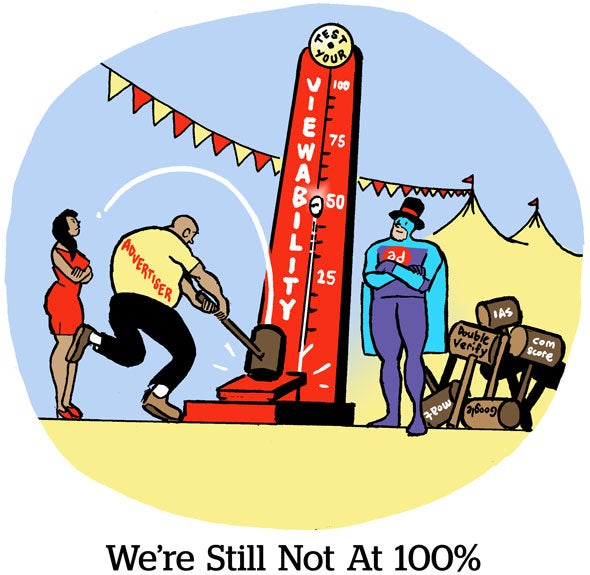
 The prospect of a viewable CPM (vCPM) standard for digital media buying had publishers running scared a year ago. Now, many are embracing the pricing model, but transacting this way is not without its hurdles.
Publishers not only need to defend the value of their inventory to buyers when 20 to 50% of the ads aren’t seen; they also face challenges in forecasting and burdensome discrepancies from ad tech vendors.
“Everything is measured. Nobody’s happy,” said Jason Baird, VP of revenue operations for Condé Nast, riffing on a line from comedian Louis CK. “Every time a new performance metric is introduced or a vendor updates with a new methodology, discrepancies increase. As there is no currency conversion from one vendor to another, it forces specific demand to be matched to a specific supply, introducing more risk to the process of delivering.”

It’s not clear if publisher revenue will improve with these added measurement standards, or if it will stagnate or decline once these standards are broadly embraced. In what’s become a stressful time for publishers, at least one buyer is promising that everything will be OK.
“Be patient, the money will come,” said Larry Allen, SVP of business development of Xaxis, speaking to a group of publishers at The 614 Group Brand Safety Summit.
Publishers who have made fixes to improve viewability find they’ve put the site’s overall inventory at risk.
A wave of publishers redesigned their sites to optimize for viewability in the past year, adding in things like lazy load, where an ad renders only once in view. Those tactics reduce nonviewable ads, but overall inventory tends to fall too.
The idea is that yield goes up when inventory is scarce, but that’s not always true. Publishers selling direct are more likely to be able to command a premium for a redesigned website with fewer ads. Making the same pitch to a DSP isn’t even possible; it’s a machine, albeit one that can optimize toward more viewable placements.
There’s also a certain perversity to how these redesigns play out. Make a video player smaller and it’s more likely to meet the standard of having enough pixels in view. But that actually makes the content and ad experience worse.
With more than two dozen vendors accredited by the MRC to assess viewability, even publishers who have successfully optimized for viewability have trouble forecasting revenue and delivering campaigns against so many different standards.
Discrepancies can reach 5 to 50% for agencies that use multiple verification vendors to measure time in view, VTR (view-through rate), nonhuman traffic and player size, said Condé Nast’s Baird.
Many sites with largely programmatic revenue or local buyers have been slow to embrace viewability standards, given the added time burden and revenue risk the standard causes. But there’s at least one sign that they’ll need to change.
Xaxis simply won’t buy anymore on cluttered sites with low viewability and poor user experiences.
Allen, speaking to AdExchanger at the event, recalled a discussion with a prospective publisher that promised it already met Xaxis’ recommendation of fewer than four ads per page. On the call, Allen saw seven ads, native advertising on Taboola and Outbrain and autoplay video.
“If you’re a publisher and you have more than four ads on a page, first of all, shame on us for buying you, but it’s not going to work anymore,” Allen said.” There’s too much waste, overhead and cost delivering ads no one will see.” Performance is going to suffer, viewability is going to be lower and ads are not going to be as effective, lowering value.”
In the marketplace, Xaxis finds that only 40% of impressions are viewable, even lower than Google’s number. At the end of last year, Google reported that 44% of impressions on its platforms were viewable.
Xaxis wants to boost the viewability number for its campaigns up to 70%. That means optimizing away from low viewability placements. When it works with a publisher, it takes the rate card and recalculates it according to vCPMs, which often dramatically changes the value of a publisher’s inventory.
“Buyers are starting to look at [rate card] as a bunk number if it’s not viewable,” said Jon Hsia, managing partner and digital investment lead for GroupM, supporting that tactic.
Publishers are doing the same thing. Condé Nast created a viewable rate card that states rates on a viewable basis, based on its calculations of an inventory’s value with viewability taken into account. It’s fully embracing new standards, with the tagline “performance is the new premium.”
If buyers fear paying too much for unviewable inventory, publishers worry they won’t be rewarded for embracing quality in a market that’s still cluttered with low-quality inventory.
One publisher, who didn’t want to be named speaking negatively of the trading desk, said Xaxis is using viewability as a bargaining tactic to push down rates, a belief that’s been echoed by many others in the industry. A better strategy would be to pay more for the ads that actually work, the publisher said, which means embracing highly viewable inventory.
Allen said publishers who fear that their rates are being muscled down versus recalibrated according to new standards “won’t be around for very long.”
“Viewability levels the playing field and drives value back to real publishers with actual loyal audiences,” Allen said.
Many publishers, including Condé Nast, are driving toward this goal but they’re still not sure if that will lead to more revenue.
“We have heard agencies say they are willing to pay more for measurable inventory,” Baird said. “If we focus on quality over quantity, and shrink available inventory (e.g., 30%), will the demand side be ready to increase rates accordingly? That is the question. The answer is in how agencies and publishers come together to find the best way to serve our clients.”