


Mobile creative is a Catch-22.
While rich media units are engaging, they’re expensive to make and tougher to scale than programmatic banners. But banners look bad on mobile and get a bad rap for ruining the user experience.
Shazam and Waze are two apps championing beautiful mobile creative, but they can do so by relying on other revenue sources. Fifteen-year-old Shazam is on 400 million devices globally and sells half of its inventory programmatically; Waze is owned by Google.
Still, their support of unique creative demonstrates mobile’s advertising potential.
Sounds Like Attribution
Shazam, which used to make money through affiliate links to iTunes, has adopted an advertising-centric revenue model as music consumption habits have shifted to streaming.
Half of Shazam’s inventory is sold programmatically through private exchanges and on the open exchange, said Chief Revenue Officer Greg Glenday. But Shazam works with 70 of the top 200 brand advertisers on custom, direct-sold creative campaigns.
“We went from banners that were ugly and annoying to custom takeovers,” Glenday said.
Shazam’s custom units are native and unskippable. Home-screen takeovers allow brands to own the app’s screen for a day, offering a wider canvas without restricting access to its song detection utility. Shazam sells just six takeovers per month at about $100,000 apiece.

“We’re never going to say, ‘We know the name of the song you just Shazamed, but we’re not going to tell you unless you watch this video,’” Glenday said. “We’ll never hold you hostage.”
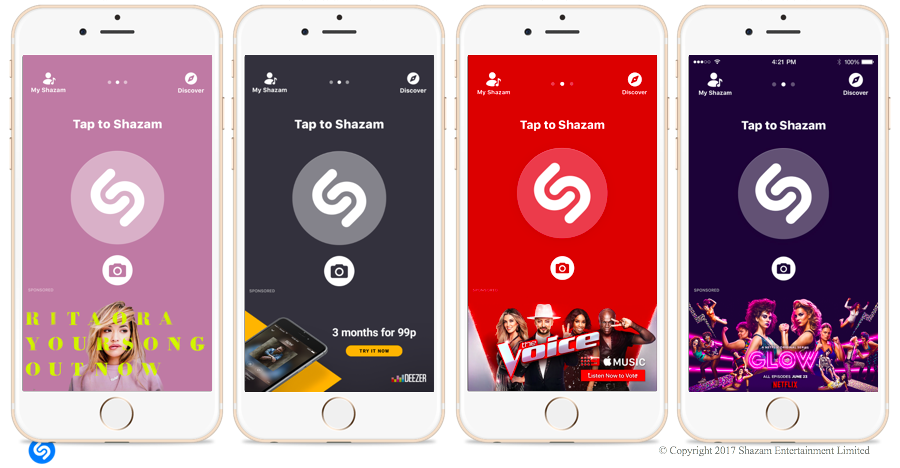
Shazam for TV extends linear TV campaigns to mobile. Brands embed Shazam’s logo on their spot as a call to action for users to Shazam the song. When they do, the TV creative appears on their phone with a coupon offer that lets brands to connect viewers to their devices.
“Our data shows us emerging songs people love,” Glenday said. “If somebody takes out their device and tries to communicate with that TV spot, that’s the holy grail.”
Last year, Shazam added a camera feature and began working with augmented reality startups to make products “Shazamable.”
Shazam placed its logo on the packaging of 150 Frito-Lay brands, prompting users to activate an AR experience through the app and enter a sweepstakes. Chip bags were Shazamed 500,000 times within the first four weeks of the campaign, Glenday said.
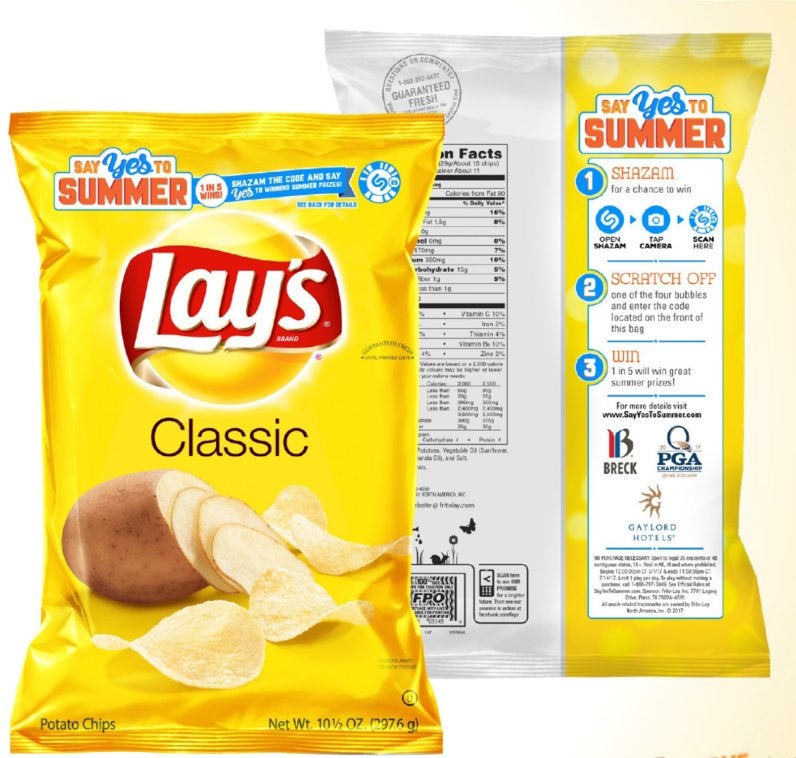 “All of the sudden, the cereal box becomes a broadcast vehicle,” he said.
Shazam will to continue to use AR creative to provide first-party data to marketers that don’t have it, Glenday said.
“Imagine users Shazam a concert ticket and Taylor Swift pops up and welcomes them to the show,” Glenday said. “A brand can get data about who is entering and send them an offer.”
But Glenday acknowledged that such ad experiences would be difficult to scale for newer devs.
“I don’t think people are going to download an app just to do this, but if you have the app you might,” he said.
Owning The Drive
Waze’s creative units combine location data with ads that reach users in a place where mobile typically can’t: while driving.
Branded pins, sold at $2 CPMs, embed an advertiser’s logo on the Waze map to indicate its nearest store location. When users tap the pin, Waze navigates them to the store and often offers a coupon at the destination. It’s an intuitive unit that offers closed-loop attribution, said Dan Brough, head of agency development at Waze.
“We’re able to measure incremental lift in navigation to store locations,” he said.
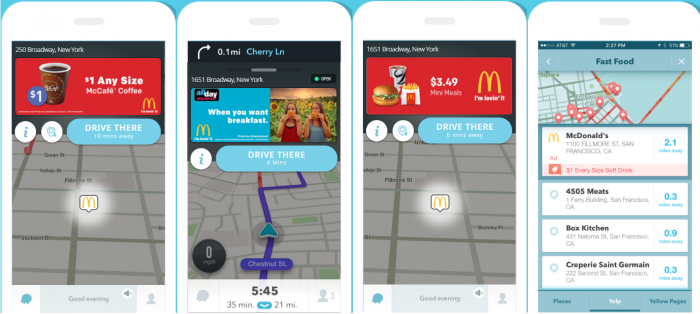
Zero-speed takeovers, sold at $25 to $30 CPMs, allow brands to take over the map screen when a car is stopped for more than three seconds. Brands can use Waze’s location data to extend their out-of-home creative onto mobile for a consistent experience, Brough said.
“You get the ad, take your foot off the brake, start idling and it disappears,” he said. “There’s no texting or tapping.”
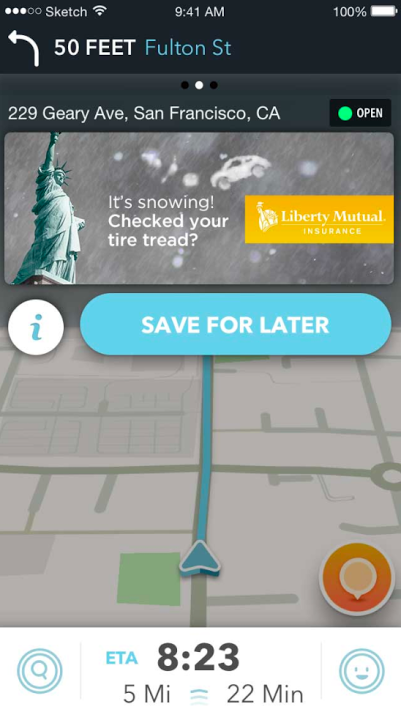 Waze pulls in third-party data to make ads more personalized. The Washington Wizards and Capitals, for example, tapped Waze to offer drivers in the DC area 20% off tickets on game day, Brough said.
“If it’s snowing in Chicago, Michelin can promote snow tires,” Brough said. “Dunkin’ Donuts can show iced coffee when it’s over 80 degrees and hot chocolate when it’s under 50 degrees.”
Waze’s most premium unit is a quarterly voice sponsorship. Users can opt for a celebrity to navigate their drive with a plug for their upcoming movie or show. Morgan Freeman, for example, got into his vice-presidential character to promote his movie “London Has Fallen.”
“He’ll say something like, ‘Secret Service says there’s an accident, slow down,’” Brough said.
But these experiences aren’t hugely scalable.
Despite being owned by Google, Waze doesn’t sell any inventory programmatically. The app is still siloed from Google’s advertising business (it doesn’t have access to search or YouTube data). But being owned by the behemoth gives it wiggle room to experiment with interesting creative formats.
“If Google paid $1.1 billion to acquire us, that’s pretty damn valuable to an agency to say it works,” Brough said.







