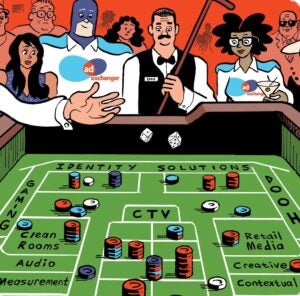
As the ad tech industry consolidates, some veterans of the space are looking to apply their skills to new fields.
One result is Orchard Platform, founded in November and led by CEO Matt Burton, formerly sales engineer for AdMeld. The platform facilitates direct lending, bringing together institutional investors, loan originators and consumers.
Most of Orchard’s 17 employees have an ad tech background, including eight who worked at AdMeld before it was acquired by Google in 2011.
Orchard closed a $2.7 million seed round in December, and Burton said the company plans to double head count in the next six months while opening an office in Europe. The company boasts more than 100 million assets under management.
Burton spoke with AdExchanger about his move into financial technology (fin tech) and how his ad tech background is helping Orchard approach the lending market.

AdExchanger: After spending your career in ad tech, what inspired the move to fin tech?
MATT BURTON: It happened organically. In watching all of the skills and lessons that we had learned in scaling up real-time bidding (RTB) and distributing from display to mobile to video, I had seen the power of those types of systems. When I realized that finance was about to go through a similar revolution that online advertising had, I jumped at the opportunity to have a front row seat at the beginning.
I saw Lending Club, which is one of the pioneers in finance, and they were in the early days of helping connect retail lenders with retail borrowers. Mainly what they were helping people do was refinance credit card debts for lower rates. When I found their site and found their marketplace, I was amazed the similarities between what I had seen in the ad tech world and what they were building. Instead of being for advertising, this was for finance.
What is Orchard Platform?
We have two sides to our business. The first is we help institutional investors deploy capital and buy loans that are being listed on the marketplace lending platforms – Lending Club, Prosper, Funding Circle, etc. We also have started working with loan originators to help connect them to institutional investors.
The most direct parallel is a system like AppNexus in the ad tech space, but in finance. Today we work with hedge funds, family offices, BDCs, wealth managers and regional banks to help them with their capital deployment.
How is Orchard similar to AppNexus?
In the same way that AppNexus gives buyers the infrastructure they need to help target online ads to buy, and how they give toolsets to publishers and other ad sellers to help them sell their ads. We provide a similar function. In the same way that AppNexus is both a server-side platform and a demand-side platform in one, we are both sides as well.
We are helping institutional investors decide – either through our algorithms or theirs – programmatically which are the best loans to buy in a fully automated way. We are also helping loan originators connect to institutional investors that are good buyers.
Has programmatic buying been used in finance before?
Programmatic buying is new in finance. Most of finance is done in a very closed system where each silo of data is not shared at all.
Think about the traditional banking model. Wells Fargo is not sharing their data with anyone.
In the online world, Lending Club is fully transparent with all of the loan performance data historically. We are able to use that and based on client needs, help them with their buying strategies when new loans get listed on the platform. We then are able to submit orders on their behalf in a programmatic fashion. Everything is fully automated.
What is the biggest challenge in introducing finance to programmatic?
The biggest challenge is that because this is built on the web stack vs. the finance stack in terms of technology, it’s a brand-new kind of world for everyone. There are obviously a lot of challenges that go along with that.
In the early days, we competed with high frequency traders who were moving into this space. It turns out that having the ad tech background and understanding the web stack is actually more important for what we are doing now than having the fin tech background.
For the market, the biggest challenge is supply. Borrowers are what everyone is trying to grow. These online loan originators or marketplaces are growing exponentially – this space is doubling every nine months – so in order to do that they have to find more and more borrowers to take out loans or finance existing debt.
You started working at AdMeld in 2008, when RTB and programmatic were just catching on in advertising. How does finance today compare with the early days of ad tech?
In the early days of AdMeld, especially when real-time bidding was brand new, a majority of the battle was education – just explaining to people that this was a better way to go about doing business.
We are in a similar place today. We are explaining how this new ecosystem has grown – for example Lending Club is going public this fall and people expect anywhere from a $4 billion to $6 billion valuation. There is a lot of education that goes into explaining why this model is better than the traditional banking model, and why as an investor you should participate.
How has your background in ad tech helped in introducing programmatic to a new industry?
I have seen the skills that we learned in the ad tech space transfer very well to the fin tech space. The skill is in understanding how exchanges work, buying strategies, how supply works, how to basically build all of the infrastructure and plumbing to make everything in an automated way that allows it to scale.
What differences are there in how you build a platform for ad tech and for finance?
The only main difference is that because we are dealing with money, the systems have to be more reliable and secure than ad tech. If something broke in the ad tech world, some publishers lost some potential revenue. We can’t really have the same result in fin tech where there needs to be accurate logging of everything. There is little to no margin for error.
What is the future of programmatic in finance?
Today, we have had a lot of success with consumer and small business loans. The technology is now being applied to real estate and larger ticket loans.
We are also now going global, so this is not a US-based trend. We are doing a lot of work in Europe. There is a ton of opportunity in Asia.
We have new asset classes to move into, as well as new geographic regions to work with. There is a lot of room for expansion over the next couple of years.