

When Taylor Swift and Travis Kelce made it official last month with a joint post on Instagram, brands hopped on the announcement like it was the last train leaving engagement station.
Within 24 hours, the post got 30 million likes, 2.3 million reposts and 9.7 million reshares.
Not every cultural moment generates that kind of buzz. But advertisers are always looking for ways to catch the wave of trending content and reach audiences in real time, said Jackie Pimentel, senior global director of ads and generative AI product marketing at Meta.
“There’s culture happening in the big moments, but there are also these smaller, more intimate moments that happen that are more meaningful to people,” Pimentel said. “At the end of the day, culture is where connection happens.”

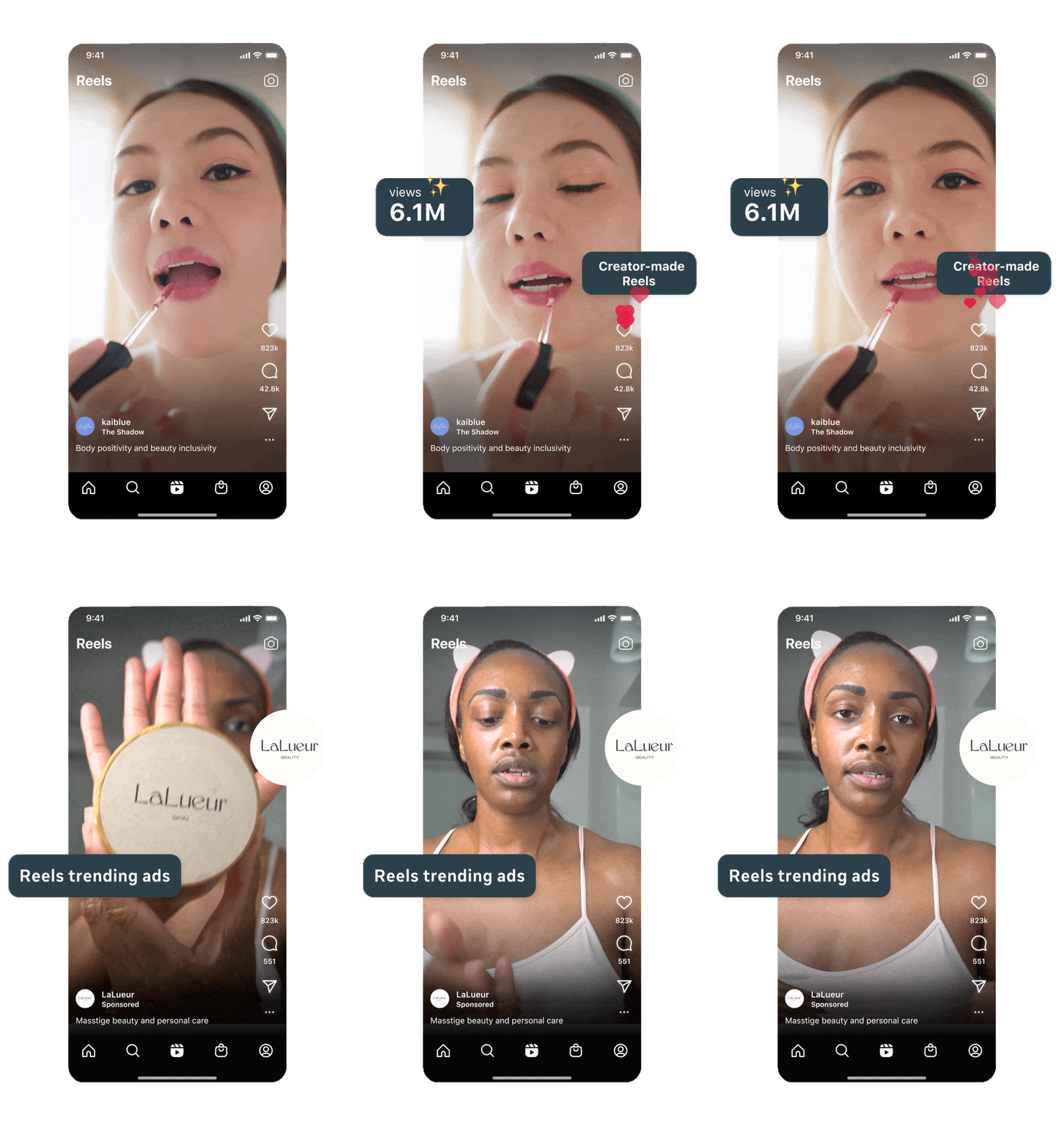
In April, Meta started alpha-testing a new ad format called Reels trending ads that places ads beside the top 5% of popular creator-made Reels on Facebook and Instagram. Top-trending content is determined daily by weighing factors like viewership, engagement, virality, brand safety and content quality.
Think of it as kind of like Meta’s answer to YouTube Select or TikTok Pulse.
On Thursday, Meta announced that Reels trending ads will be available starting in November on a self-serve basis through Ads Manager to all advertisers who have a sales rep.
Advertisers can choose to run these ads against trending content overall or against specific categories, such as fashion and beauty, cars, sports, animals and pets. The plan is to roll out additional content categories by next year.
The Reel deal
According to Pimentel, Meta has done its own analysis with several brands and found that Reels trending ads generate a roughly 20% lift in unaided brand awareness, which is on par with YouTube Select and better than TikTok Pulse.
The numbers are evidence that cultural moments can be brand-building moments, she said, so long as brands are able to discover them and tap in.
“We’ve invested a lot in our recommendation system and our discovery system,” Pimentel said, “and this same AI is powering experiences that help brands get discovered and connect with their audiences.”
In July, Meta told investors that advancements in its AI recommendations system helped boost time spent on Facebook by 5% and Instagram by 6% in the second quarter.
The sheer volume of engagement with Reels – around 5 billion Reels are shared daily and roughly half of time spent on Instagram is with Reels – means there’s a heck of a lot of potential Reels trending ad inventory.
“Creators are creating Reels at an accelerated rate, and people are spending more and more time with Reels,” Pimentel said. “We see no shortage of inventory or opportunity.”
Loose ends
Threads, meanwhile, Meta’s alternative to X, which launched in 2023, is also growing – it now has 400 million monthly active users – albeit at a slower pace.
For now, most brands don’t yet see it as a must-buy, but Meta is trying to change that, including by making it easier to expand their Instagram and Facebook campaigns to Threads. Brands that don’t have a Threads profile can now use their Instagram account to run Threads ads and also use Ads Manager to repurpose Facebook and Instagram posts to create ads for Threads.
Meanwhile, starting “soon” (Meta didn’t share specific timing), some advertisers will be able to test carousel ads, Advantage+ catalog ads and app ads on Threads.
“It’s not unusual when we launch a new placement for it to take a minute,” said Pimentel, who helped with the initial rollout of Threads. “Our focus now is on continuing to add more features and make it seamless for brands to integrate Threads into their existing media plans.”
Value added
But Meta is also focused on developing tools that combine brand marketing with performance.
Last year, it started testing a feature called “conversion value rules,” which allows advertisers to automatically optimize their campaigns based on their own definition of a valuable conversion, whether that be sales, lead generation, lifetime value or other business-specific metrics.
Now, Meta is expanding value rules to upper-funnel objectives, including brand awareness and engagement.
“Brand marketing performs and performance marketing builds brand,” Pimentel said. “You need the whole funnel to build a business.”
Value rules are now generally available to all advertisers.
Stick the landing page
Lastly, Meta also announced on Thursday that it’s releasing an enhanced version of landing-page optimization, which is a feature that automatically selects the page on a brand’s website that’s most likely to lead to a conversion after someone clicks on an ad.
This feature relies on the Meta pixel, which tracks visitor actions on a site so Meta can determine which pages will work best for each visitor.
But some advertisers “aren’t able to leverage the Meta pixel, such as a CPG brand driving to a partner site where their products are sold.” That’s how Meta put it in its blog post announcing the news, which kind of sounds like a way to say “Amazon” without actually saying Amazon.
The updated version of the landing page optimization feature works without the pixel, using Meta’s own first-party data instead to optimize the destination for ads with a traffic-driving objective.
And it’s not just about circumventing restrictions on Amazon, Pimentel said.
“That’s a valid example, but it’s not the only one,” she said. “We’re just trying to reduce the technical limits for brands to meet their goals.”










