 Account-based marketing, or the ability for a B2B marketer to target a cross-section of companies, has been around for a while, but the techniques are becoming increasingly sophisticated.
LinkedIn recently launched company targeting on its platform, and Demandbase, which has had an account-based marketing solution in-market for several years, extended the tool to the Oracle Marketing Cloud on Wednesday – enabling B2B marketers to add precision to what was once a blunt-force instrument.
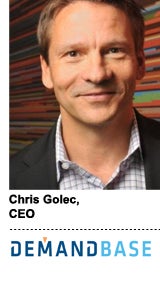
“In traditional marketing automation, someone downloads a white paper or fills out a form online and you nurture them from there,” said Chris Golec, CEO of Demandbase. “With account-based targeting, you’re not so reliant on actions like [a form fill], which only happens about 2% or 3% of the time on a company’s website.”
B2B marketers also struggled to effectively target beyond their immediate email lists, which often included data that was out of date, and limitations like a lack of cookies on B2B websites made tracking less consistent in digital.
Instead of just targeting a specific role at a company, such as “VP of sales,” account-based marketing lets marketers reach a cross-section of decision-makers at a company based on a combination of network IP data and CRM/email data. Think of it as a form of personalized audience extension, but for companies and accounts that share similar traits.

One new feature for Oracle customers, enabled by Demandbase, is account scoring, or the ability to see which segments are most engaged with a company’s digital assets.
“Knowing that you have a lot of people visiting your site from a certain industry that maybe you’re working with presently or messaging, is really valuable for marketers in the B2B space,” said John Stetic, group VP of products for the Oracle Marketing Cloud. “By eliminating the wrong accounts from the start, that’s where the biggest waste is, frankly.”
Because Demandbase’s data network spans more than 50 access points, including exchanges like Google’s DoubleClick, marketing platforms like Salesforce, web analytics, CMS systems and a database of corporate IP addresses, Golec claims it’s in a unique position to combine “firmographic” and behavioral data for personalization.
So while LinkedIn’s differentiator is a large, logged-in audience, Demandbase argues the B2B sales cycle largely begins on a company’s website, so through all its data hooks it’s able to gauge a more complete view of a company’s end prospect throughout the purchase funnel.
Plugging into a marketing automation system with wide penetration like Oracle gives Demandbase much more scale and client adoption.
Golec sees potential not only to improve conversion rates around standard channels such as email, but to send more data signals about which companies should be served an ad versus which shouldn’t. Or, which landing pages or microsites a company should personalize.
This capability requires a lens into broader ad stacks, a marketer’s CRM and marketing automation system, he said.
“That allows you to move away from a CPM model, which is somewhat meaningless in B2B and now employ a subscription model,” Golec said. “Instead of a $20 CPM, it might be $100 a month for each company you want to sell to. That’s much easier to translate into a cost of sale for a B2B marketer.”