
 AOL finally answered the question “What is a programmatic upfront?” by saying it would put its money where its mouth is: starting in 2014, it will make its reserved, guaranteed inventory available through its automated platforms for the first time.
The portal lined up an array of advertising partners, noting that five of the six major global ad holding companies were represented, including Publicis Groupe, which began working with AOL on an initiative dubbed Publicis AOL Live in July, along with Interpublic Group’s Magna Global, Omnicom’s Accuen, Havas Media and independent media shop Horizon.
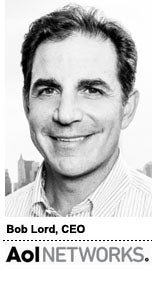
WPP’s GroupM is the lone holdout, with some executives close to both companies saying that it prefers to build its own programmatic system alone. Nevertheless, a list of the shops involved are heavily tilted toward Publicis, which is natural given the earlier relationship the two set up this summer, when Bob Lord, who heads up the PAL project, said he would leave his post as CEO of Publicis interactive agency Razorfish.
“This is about us talking to agencies and advertisers and asking them to make commitments to our technology and to the future of how the business of advertising is going to be conducted,” Lord said after his presentation when asked to explain why the event deserved to be called an upfront. “With the traditional TV upfront, buyers commit to spending ad dollars on inventory for a TV series. Here, we’re asking brands for a commitment to make an investment in technology. If I know I’ve got a ton of brands who want a particular service, I can build it for them and because I have that commitment, I can build it at scale.”

The amount of inventory AOL is making available is estimated to be in the hundreds of millions of dollars. Given that AOL’s upfront was dominated by presentations from the agency partners, the message appears to be that AOL has lined up several million dollars already. The timing of the event was no accident, of course. Aside from being held on the first day of New York’s Advertising Week, late September is a time when media buyers start examining their budgets for the Christmas holiday season and the typically weaker Q1 period. At the very least, AOL’s business will likely get some boost as a result of the work it put in over the past few weeks.
So far, AOL has guaranteed programmatic upfront deals with Hyatt Hotels & Resorts and LG Home Appliances; representatives from those marketers appeared with their respective agency partners to tout their devotion to pushing brand campaigns dollars through programmatic channels.
“The idea that programmatic doesn’t require planning is ridiculous,” said Amir Ashkenazi. “If anything, it requires more advanced planning. You need to find the right platform, you need to find the right data in order to define the right strategies.”
Earlier, Toby Gabriner, president of Adap.tv, and Lord, emphasized the time-saving value of using automated ad processes for “premium,” guaranteed ad dollars by saying doing so will give back “brain space” to agencies for more creative thinking.
“We know we’re losing 40 to 60 percent of marketing dollars to inefficiency,” Lord said during his presentation. “I personally know that creative agencies have to fight the mundane. We have to embrace the undeniable truth that technology and media are coming together.”
As for the commitments to technology Lord talked about, the other big piece of information that AOL sought to convey was that AdLearn, which has generally been considered AOL’s demand side platform, will now be considered a fuller marketplace system by next year, said Seth Demsey, SVP of global advertising products and strategy for AOL Networks.
“AdLearn will be more than a DSP, with reserved and non-reserved being sold on the same platform,” Demsey said. The expanded AdLearn will have ability to do three new things: frequency capping; built in reach and frequency settings for reserved and non-reserved; and direct buying connections into publishers’ private marketplaces. Much of the new capabilities are being powered by online video marketplace Adap.tv, which AOL acquired a month ago for $405 million.
While there was some grumbling about the notion of the TV upfront being transposed for what some described as a technology showcase, AOL executives felt that the idea of committing future spending made the term useful for media buyers to easily grasp. Still, some will take some getting used to, even as the series of videos and presentations rivaled the glitz and spectacle typical of the broadcast and cable TV networks upfront extravaganzas.
“I’m not sure if upfront is the right way to frame it,” said Amanda Richman, president of Investment & Activation at Publicis’ Starcom. “Bringing premium inventory into an exchange environment, making it more available and on-demand is sound for the industry to operate in a more automated way. But in terms of an upfront, which signals a period of buying and negotiation, it’s hard to say with this is the right label. But the intent is right.”









