

 Fitness app RunKeeper is trying to monetize for the first time via a partnership with mobile rewards ad network Kiip to embark on a subtle version of advertising – but don’t call it advertising.
Kiip founder and CEO Brian Wong doesn’t really like the word, mainly because for many people mobile advertising is synonymous with low-performing banners and disruptive static interstitials.
“We don’t want the consumer to feel like this is something funded by an advertiser, and that’s intentional,” Wong said. “We want to change the way people are perceiving what’s happening on mobile.”
The way Kiip and RunKeeper, which has more than 34 million global users across Android and iOS, plan to do this is through a rewards system that capitalizes on in-the-moment actions.
The RunKeeper app allows users to track their fitness activities (such as running, biking, walking and skiing) and view statistics on their completed tasks, including time, distance, pace and altitude. In addition to tracking performance, the app notifies users of particular achievements and personal bests.

These milestones are the foundation of RunKeeper’s partnership with Kiip.
When a RunKeeper user achieves a particular goal, Kiip enters the scene by targeting that person with a relevant offer from a brand partner, including Pebble, Quaker Oats and P&G’s deodorant brand, Secret. The actual offers are informed by the activity the user just completed, as well as time of day, location data and any other relevant behavior information that might be housed in Kiip’s database. [Kiip recently hooked up with VivaKi to bring Kiip rewards to Publicis clients.]
The object is to bestow meaningful, targeted rewards that spark action when users are at their most engaged, rather than serving mobile display ads that just generate awareness.
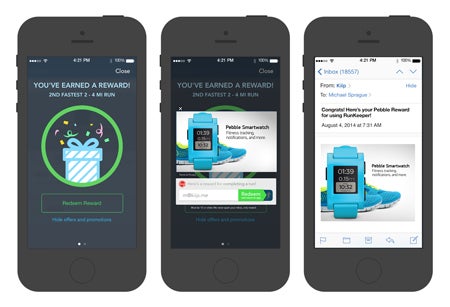 “It enables us to connect artfully curated brands with users at key moments when those users are most inclined to care about those brands,” said Jason Jacobs, co-founder and CEO of RunKeeper. “This works well for us because it rewards users in an interesting way without being obtrusive.”
Also noteworthy is Kiip’s frequency-capping function. Users are not rewarded more than three times a day. They’re also not rewarded after every activity or blasted with repetitive offers after having redeemed something. If a user doesn’t redeem a particular offer, he or she is presented with the next relevant offer in the queue at the next appropriate time.
“What we’re not trying to do is bombard users,” Wong said. “Just because you liked something once doesn’t mean it makes sense to then go ahead and show you the same exact thing 40 more times.”
As far as KPIs, Jacobs said RunKeeper plans to track how users are engaging with the rewards, as well as customer satisfaction and loyalty using the net promoter score.
“Our hypothesis is that if we surface rewards at key moments built into the right experiences at the right time, then that will act as an incentive to get people to go out and do more activities using the app,” Jacobs said. “But we also need to ensure that the rewards don’t do anything to take away from people’s love for the products.”
RunKeeper ran beta testing with Kiip for about a month before the official integration. According to Wong, the app saw “double-digit” engagement numbers during the test period.
“You’re going to see high engagement levels with a fitness app, especially, because users genuinely want to be recognized with real rewards rather than a slap on the back or a badge or something,” noted Wong, who said he’s looking at the RunKeeper integration to act as a kind of proclamation to the industry that mobile banners are not the way forward.
There’s a lot of discussion at the moment as to what brands and developers can do to inject some creativity into mobile ad units. The RunKeeper/Kiip integration seems to cleverly circumvent the debate by shifting the focus from advertising to offers housed within an app’s core capabilities.
“A lot of functional apps feel helpless because they don’t have virtual currency, which is the main driver of the game app ecosystem, and banners seem like the only way for them to monetize,” Wong said. “What we want to do is to show them that there is an alternative to banners.”







