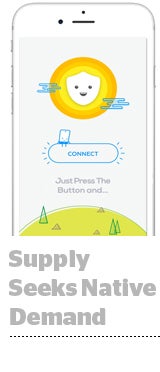
 App publisher Betternet is eschewing banners in favor of native because the results are better and the experience is less annoying for the user – but getting enough quality demand can be a challenge.
“This year I observed that the fill rate for most of the ad networks we work with is sometimes even less than 50%,” said Alex Madsen, who handles revenue and monetization for Betternet, a free VPN app with around 40 million users.
To that end, Betternet recently started working with PubNative, a mobile SSP for native ads which launched a native mobile mediation solution on Thursday.
The solution, a bit like what MoPub offers, allows app developers to automatically manage placements across multiple native demand sources. PubNative is in the midst of the certification process with Facebook, Google and Yahoo.
Developers can also layer on mobile-specific segmentation parameters, including app use, device type and OS, as well as other targeting parameters like country and demographics.
But why the need for a separate mediation solution just for native?
According to Ionut Ciobotaru, managing director and co-founder of PubNative, native is still very much its own beast despite moves toward some standardization around native ads aligned with particular app types and categories.
Although native units may look relatively uniform across messaging apps, for example, or utility apps, there’s not enough standardization to make it easy to maximize fill rate with native demand across the board.

“You can run the same banners with anyone and there’s no real difference, but on native, everyone has a somewhat different approach,” Ciobotaru said. “There are different formats and different assets and publishers need a specific solution to aggregate and understand it all.”
Although Betternet still uses interstitials to monetize in certain cases, full-screen ads are too disruptive to the user experience to tap into too often. About three months ago, Betternet started reallocating dollars from traditional in-app display to native placements mediated via PubNative.
Right off the bat, Betternet noticed its fill rates jump into to the high 90s-percent range, with a 200% increase in the average revenue per user. Engagement is also up from 1% with Google banners to 3% with PubNative units.
A lot of that has to do with the audience segmentation options, Ciobotaru said.
“Advertising and data are made to work together,” he said. “You need to know who users are if you’re going to show them the right advertising to get them to engage. That works very well for Facebook, for example, because they know so much about their users.”
But so do app developers. They’ve got access to vast storehouses of useful data – everything from why someone is using an app to when and where that person is using it and on what type of device – but other than Facebook’s aforementioned mobile dominance and the free-to-play behemoths like Zynga, King or the now Tencent-owned Supercell, most don’t take advantage of it.
Betternet is starting to make progress on that front. Something as simple as segmenting its users by country, for example, has had a positive effect on its bottom line.
When the Brazilian government ordered phone carriers in the country to block WhatsApp for three days in May in a dispute with Facebook over access to encrypted data, there was an immediate and precipitous drop in eCPMs for Facebook demand.
It was still possible for people in Brazil to use WhatsApp during the ban through a VPN, which was an opportunity for Betternet – according to Opinion Box, WhatsApp is the most-used app in Brazil – but monetization just wasn’t working out.
When Betternet started segmenting out its Brazilian users and accessing native demand from non-Facebook sources, eCPMs increased from 10 cents to about $1, where they normally were.
Betternet plans to get more granular with its segmentation in the near future by serving ads based on why someone is using its VPN service. The person who uses Betternet to watch Netflix in China, say, is very different from the person who uses Betternet for security purposes, and it makes sense to hit them with different messaging.
As more native demand comes into the market and “native becomes less of a buzzword,” said Ciobotaru, developers are starting to embrace the format as a central part of their monetization strategy. They just need a way to sell all their inventory and manage the competition.
According to research released by IHS and Facebook in April, native ads are on track to make up 63% of mobile display ad spend by 2020, and a recent report from MoPub noted a 385% year-over-year increase in overall native supply between Q4 2014 and Q4 2015.