

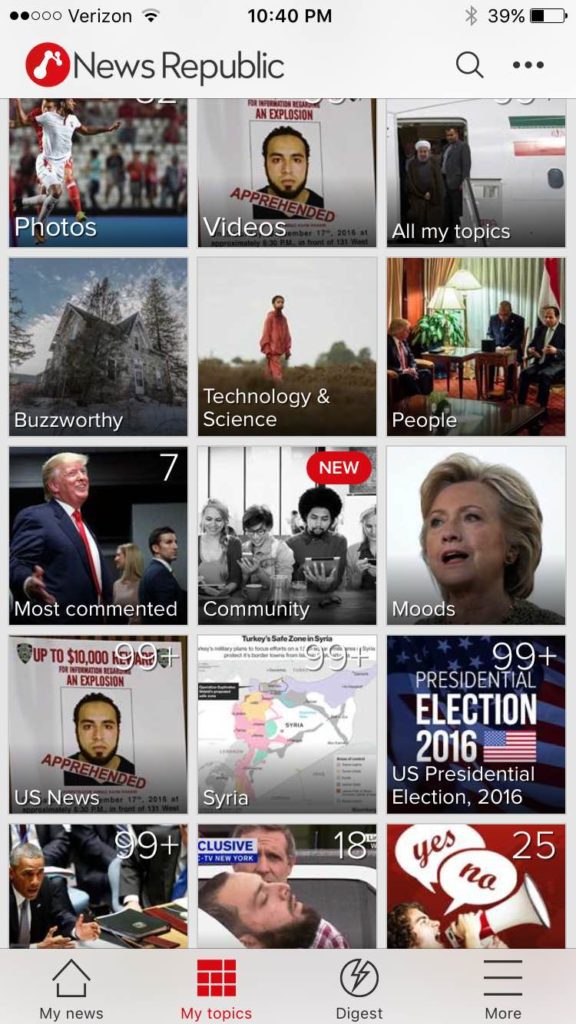
 News Republic users read about 200 pages of news stories per month.
 “That’s like reading a big book of news every 30 days,” said CEO Gilles Raymond, who founded the news aggregator app in 2008, the same year the App Store launched.
It’s that level of time spent that attracted Cheetah Mobile. In August, the Beijing-based utility app publisher, which has more than 620 million global monthly active users, bought News Republic for the hefty price of $57 million.
Users don’t spend a ton of time in Cheetah’s utility apps beyond downloading them, which is where News Republic comes in.
Cheetah has an enormous user base, roughly 80% of which is outside of China, and wants to pivot to a wider content play. News Republic has the content chops and the publisher partnerships, but it’s also facing looming competition from the likes of Apple News, Facebook Instant Articles and Google’s AMP.
“Our common vision is very simple,” Raymond said. “We want to build the biggest mobile media company in the world together. But it all starts upstream.”

Considering Cheetah’s user base is almost twice the size of Twitter’s, it’s not a grandiose vision. Utility apps will serve as entry point while data-driven content engages and retains. The duo hopes mixing personalized content from News Republic and distribution and monetization from Cheetah will attract users – and, by extension, advertisers.
News Republic also brings Cheetah a new form of consumption data.
Rather than relying on RSS feeds, News Republic has direct relationships with more than 1,600 publishers, including CBS, The Washington Post, the San Francisco Chronicle and The Guardian, and pulls in roughly 50,000 articles a day from its publisher partners.
Users follow the topics they’re interested in and get personalized story recommendations based on what their friends are reading, while the app collects data every step of the way.
“We aggregate all of this data to power our recommendations,” Raymond said. “But with Cheetah, we have the chance to deliver high-quality news and advertising linked to user profiles.”
For the last year and a half, Cheetah has been building out an ad platform underpinned by the technology it acquired from French mobile affiliate network MobPartner in March for $58 million.
“The initiative speaks to a pivot happening within Cheetah Mobile,” said Todd Miller, who joined Cheetah as VP of global sales in May after more than 13 years in sales roles at Yahoo, most recently as VP of emerging markets. “Utility apps are a good business to be in and they’ve generated a significant amount of revenue, but we’re looking for our future state, and that future state is content.”
The acquisition also solidifies News Republic’s foothold in China, where it has deals with a number of large phone manufacturers, including HTC and Samsung, to be the default news app on their handsets in China.
It wasn’t easy making that happen, though. It took about three years of struggling before News Republic was able to make any headway in China. “Frankly, it was a nightmare and very challenging,” Raymond said. “The level of competition in China is incredible.”
Making it onto the OEM handsets also turned out to be a coup in another way. “A big reason why Cheetah approached us because we had visibility and credibility in China,” said Raymond.
But the go-forward plan includes growth beyond China’s borders.
“Even after reaching the high level of penetration that Cheetah has, they still need to grow and encourage recurring usage and worldwide consumption,” Raymond said. “And that is where we help, because the reading of news is universal. People read news no matter who they are or where they are – whether they’re 10 years old or 90 years old or whether they’re in Africa or America or China.”
This is the sixth installment of Home Screen, a series of profiles on mobile pubs and apps and the devs who make them (and hopefully make money on them). Read about home décor app Lux, teen voting app Wishbone, wedding planner platform The Knot, lip-syncing app Musical.ly, pop culture magazine Movie Pilot, on-demand laundry app Cleanly, music streaming app LaMusica, P2P global shopping app Grabr, kid-friendly chat app Jet.me, driving app Dash, anonymous app Whisper, storytelling app Episode, weather app Poncho, online writing community Wattpad and sticker app Emogi.







