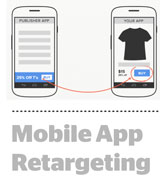
 Retargeting advertisements across mobile apps is quickly becoming a critical component of app developers who want to not only drive app installs but also move to the next step: driving continued app engagement among current users.
“We’re spending a lot of money getting users to download our app and it wouldn’t make sense to stop trying to reach those people once they’ve downloaded our app,” said Russ D’Souza, co-founder of SeatGeek, an app that helps users find deals on sporting events and concerts.
Because marketers can’t track mobile app users the same way they would track users on a desktop (i.e. using a cookie), they are turning to other approaches to deliver the right ad to the right consumer at the right time. One example is the mobile retargeting firm URX. The San Francisco-based startup places targeted ads on other mobile apps that direct consumers to the purchase pages for specific products.
For example, if a smartphone user browses tickets to a New York Knicks game on SeatGeek but closes the app before making the purchase, URX can match the smartphone’s device ID via Apple’s IDFA or Android’s Advertising ID with other information about the game from SeatGeek’s API to push an ad about the Knicks game.

URX also will look for patterns in the time of day and other historical purchase data to estimate when best to show the user an ad reminding him or her about the game. The ads show up as display ads that URX pushes to other apps through a mobile ad exchange.
What also makes URX’s service interesting, according to D’Souza, is its deep-linking capability, i.e., linking to a specific page within a separate website instead of the site or app’s default screen. “A user doesn’t want to have to go back to an app, type in the ‘New York Knicks,’ find the game and then buy the tickets,” D’Souza said. “URX will take users [who click on the ad] straight to the tickets page and make the transaction even easier.”
Other companies such as Facebook, Google and Twitter also are getting into the deep-linking game. Google announced in October that it is experimenting with adding deep links to Android apps in its search results. Facebook recently rolled out mobile app engagement ads that include a deep-linking feature and Twitter has added deep-linking features for apps to its Twitter Cards.
CEO John Milinovich described Google, Facebook and Twitter’s deep-linking efforts as a sign his company is on the right track.
“What’s interesting is the lifetime value of an app user hasn’t been very high, and that was okay as long as the CPI [cost per install] was also low. But what’s happening is CPIs are starting to rise and so marketers are starting to think about how to increase the value of their current customers,” Milinovich said. “We’re excited that people are starting to think about their post-acquisition strategies on mobile now and even though other companies are entering this space, we’re focusing on providing the most value that we can to marketers.”