

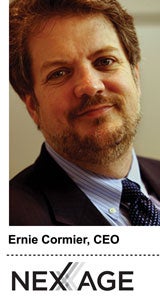
 Mobile advertising exchange Nexage has become one of the largest independent mobile ad exchanges following Twitter’s decision to snap up its competitor, MoPub. As competition in the mobile ad space continues to heat up, it remains to be seen what Nexage’s next steps will be. AdExchanger spoke with Nexage CEO Ernie Cormier about the company’s road map, private vs. open ad exchanges and the development of the mobile RTB space.
AdExchanger: What has been the impact of Twitter’s MoPub acquisition on your business?
ERNIE CORMIER: I think it’s worthwhile to start with what is it that Twitter saw in a mobile ad exchange. There are a couple things Twitter has that fit an ad exchange. One is a significant proprietary data set that can be used for data mining, including audience building and segmentation, or even inference-based demographics. Twitter also has the ability to link online users across devices through its login … and apply that knowledge across screens for addressable advertising.

As long as you have a way to link those data points to incoming ad requests, you’ve got an asset that you can monetize really well. And the fact that Twitter recognized the value of a mobile exchange by buying MoPub has catalyzed the industry.
What it [the Twitter acquisition] has done is increase interest in the value of in-house data and how data can be applied. We launched Nexage Connect with the intent of bringing that data into the exchange and now more companies, whether they’re a publisher or a data provider, are showing interest in what mobile ad exchanges can do to help them monetize their data.
What are you seeing in terms of growth in mobile RTB spend?
As we were building our 2013 budget we expected RTB would grow at a fast clip. That was back in Q4 2012 and RTB was about 10-15% of spend on the Nexage Exchange. Well, we got it somewhat wrong – in a good way. We underestimated the growth of RTB and now about 60% of spend is through RTB. In hindsight it makes sense: Publishers value better performance and better transparency; buyers value impression-level decisioning.
I will say one of the more interesting dynamics is on the buy side, where you have the combined effect of mobile native and online native DSPs growing, ad networks shifting to programmatic buying and trading desks getting more active. That tells me that next year we will be well past the 60% number.
Who are your biggest buyers? Are most of them direct-response marketers?
Our buyers are DSPs, mobile and online-native as I described, ad networks, trading desks that may license technology and some advertisers. It is a diverse and growing set of great customers that are rapidly building out their programmatic buying business – and good for them. They are about to see additional benefits as agencies double down on mobile and mobile programmatic.
To your second question, most of the advertisers on our exchange are brand advertisers that run a host of different campaigns from brand awareness, to hyperlocal to call-to-action campaigns. Direct response is a large percentage of the business, but we see evidence internally of growing brand spend, which is really what we are targeting. We’re seeing more brand spend come in now and we expect it to grow rapidly next year. Our strategy is to reduce any friction for brand spend by making it a safer environment from a brand safety point and improving the ability for metrics and ROI calculations.
What is the percentage of brand ad spend on your exchange?
Brands can run all different types of campaigns. As we look at our business now – especially on the heels of Black Friday – brand spend is 60% to 70% of spend as brands use mobile to drive holiday sales.
Do you deal mainly in private exchanges?
Through Nexage Exchange, we offer both public and private exchange capabilities for our customers. We launched our private exchange about two years ago and we originally thought of it as a specific product. We’ve learned that it’s actually more like a set of capabilities.
We end up using some form of private exchange for well over 25% of our publishers at this point but there are still many publishers who are basically sitting on an open exchange and leaving it to us to manage the buyers.
We have capabilities such that we can turn off or on any given set of buyers or sellers. We can blacklist, whitelist — do all kinds of filtering. So private exchanges are really a set of business rules that allow us to meet the needs of publishers that tend to have some kind of complexity in their business.
If there is a trend to watch, it is the uptick of private exchanges, as that is one of our most important growth drivers. The numbers are pretty staggering; we grew private exchange revenue 569% in Q3. This growth is happening because private exchanges offer our customers incredible value and flexibility.
Are there any numbers you can share? What is the volume of mobile ads on your platform? Total ad requests? Total impressions?
We were managing about 35 billion impressions per month and that number is accelerating right now as we have seen a great November and early December. That produces about 400 million unique users.
Where is the company in terms of revenue and growth?
Nexage is on pace to better its 171% growth from 2012. We saw a great November and Black Friday push and December off to a strong start. It is fair to say that brands will increasingly look to mobile to drive brand awareness, m-commerce and in-store sales.








