

 Kids are accustomed to lying about their age. Most don’t bother with getting their parents’ permission to use Facebook, Kik, Whisper, Snapchat, Instagram et al.
 And that makes the data resulting from their usage quite murky, said Jenny Mirken, CEO and founder of Jet.me, a chat app and social network developed with the preteen set in mind (not to be confused with the Walmart-owned ecommerce site, Jet.com).
“You really can’t find these kids on any other social app right now, because they’ve all had to lie about their age to participate,” said Mirken. “There’s a lack of data that’s available to marketers around this under-13 audience.”
But there’s a reason most social platforms treat children’s data with kid gloves: the Children’s Online Privacy Protection Act (COPPA).
Jet.me, which launched in September after a prolonged beta, claims to be COPPA-compliant, a status it achieves by running two concurrent apps, one for kids and one for parents.
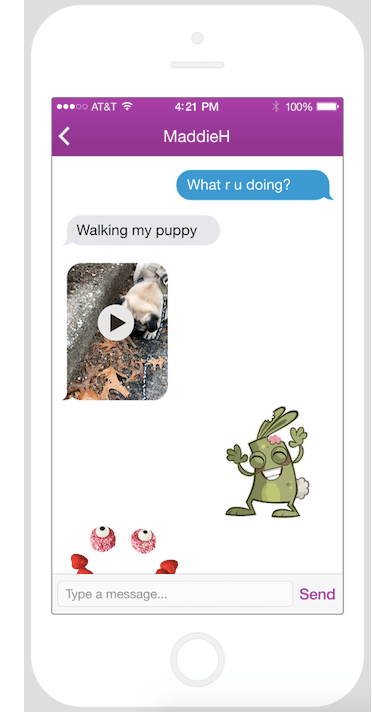
The titular app, Jet.me, allows kids to message their friends and share content through a newsfeed-inspired “Jet Stream.”
But before they’re able to use it, a parent is required to download a second standalone app, dubbed Jet Parent, which costs 99 cents, the minimum amount it’s possible to charge. The act of purchasing the app creates a credit card transaction that counts as parental approval, as required by COPPA. Parents can also use the app to vet and approve their child’s friend requests on Jet.me.
Jet is banking on the insights it’s able to gather, within the parameters of what’s allowable under COPPA, as “a big monetization opportunity,” Mirken said.

Things like profile picture, name and username are considered personally identifiable, but there’s a lot of value in anonymized aggregate profile data for this audience, which has historically been difficult to reach. The data just isn’t there, Mirken said.
For example, during a focus group, Jet spoke with one 10-year-old girl who said that she and her friends always enter “8-8-88” as their fake birthday when they sign up for things because it’s easy to remember. But that means a 10-year-old is likely being targeted with content that’s appropriate for a 28-year-old. It’s first-party data, but it’s willfully inaccurate.
According to a report from BBC Newsround in February, roughly 75% of children between the ages of 10 and 12 have a social media profile, despite the fact that most services don’t allow anyone under 13 to join.
“The fact of the matter is, if kids can’t be themselves on chat apps and portals, they’ll be forever mismatched with content they actually want to see,” said Mirken, who noted that her own 12-year-old nephew signed up for Snapchat by saying he was born in 1968.
“When I heard that, I thought, ‘Well, you’re about to see a lot of stuff that doesn’t at all match who you are and what you love,’” she said.
 To that end, Jet.me plans to collect the type of anonymized behavioral data that makes the rest of internet advertising tick – interests, engagement, content consumption, time spent and the like. (Jet also asks for first name, surname, gender, birthday and email address during the signup process, although this info is never shared with third parties.)
But there are also a number of non-intuitive data points that Jet could provide to marketers, like time of day, Mirken said. For example, there’s no point in sending out notifications if the intended recipients are in the middle of math class.
“That’s always been a big question mark,” she said. “Every school has different rules about phone usage, and kids don’t always have their devices with them. Their devices might not even leave the house in the morning. A question marketers would like to answer is ‘When and how are kids engaging?’”
Right now, Jet’s main goal is to spark organic engagement and encourage user-generated content, but the plan is to monetize through content partnerships with brands down the line. Original sticker packs are a particular focus.
According to COPPA, it can be acceptable to serve targeted ads to children, even if they’re under 13, as long as the appropriate parental consent is obtained and certain other restrictions are respected, including not collecting geolocation data.
“But we’re looking for ways for brands to participate without dropping banners into a kid’s stream,” Mirken said. “Kids deserve better than what they’ve been getting on mobile and chat.”
This is the tenth installment of Home Screen, a series of profiles on mobile pubs and apps and the devs who make them (and hopefully make money on them). Read about home décor app Lux, teen voting app Wishbone, wedding planner platform The Knot, lip-syncing app Musical.ly, pop culture magazine Movie Pilot, news app News Republic, laundry startup Cleanly, music streaming app LaMusica, P2P global shopping app Grabr, anonymous app Whisper, storytelling app Episode, weather app Poncho, online writing community Wattpad and sticker app Emogi.







