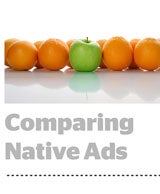
 As native advertising accelerates, the terminology lags behind. “Native” as a buzzword now encompasses a wide range of solutions – leading to confusion within the industry.
One debate is whether in-feed ads (ads inserted in between content) are by default native ads, and whether it should matter.
Facebook, Twitter, Yahoo and AOL all offer in-feed ad units that they are calling native ads. In-feed ad units, however, are being lumped together with content marketing products as native ads, even though there are several differences, according to DistroScale co-founder and product marketing VP Stanley Wong.
Distroscale is a native ads startup founded a year ago by a trio of Glam Media veterans that offers a content-management system, ad server and marketplace to buy, format and distribute a brand’s content across websites, the mobile Web and apps.

“Content marketing is getting noisy with more companies coming in that mainly drive traffic (through in-feed ads), rather than distributing content in a way that truly matches a site’s content,” Wong said. “That distinction still needs to be made clearer.”
The problem is largely semantics. “Native” is one of the most confusing terms in mobile today, maintained Forrester Research analyst Jennifer Wise. “It takes on too many meanings,”said Wise, who noted that the term applies to apps that are supported on a mobile device; traditional sponsored messages inserted into an editorial product, as well as ads that match the look and feel of a site but may not offer relevant content.
The IAB tackled the definition of native ad units in a white paper, “The Native Advertising Playbook,” and noted that in-feed ads have the largest number of variations.
One way to address the variety of units is to look at certain characteristics. How well does the ad unit’s behavior and message match the surrounding content and does the ad function like other elements on the page (e.g., a video ad among videos) should be among the questions marketers ask, the IAB advised.
Whether in-feed ads should be distinguished from other native ads is also uncertain. “Native is in the eye of the beholder,” the IAB noted in its report. “And so is the buying and selling of it, reflecting the infinite variations in advertiser objectives.”